Try, learn and adjust
Check clean-cooking information reaches decision-makers
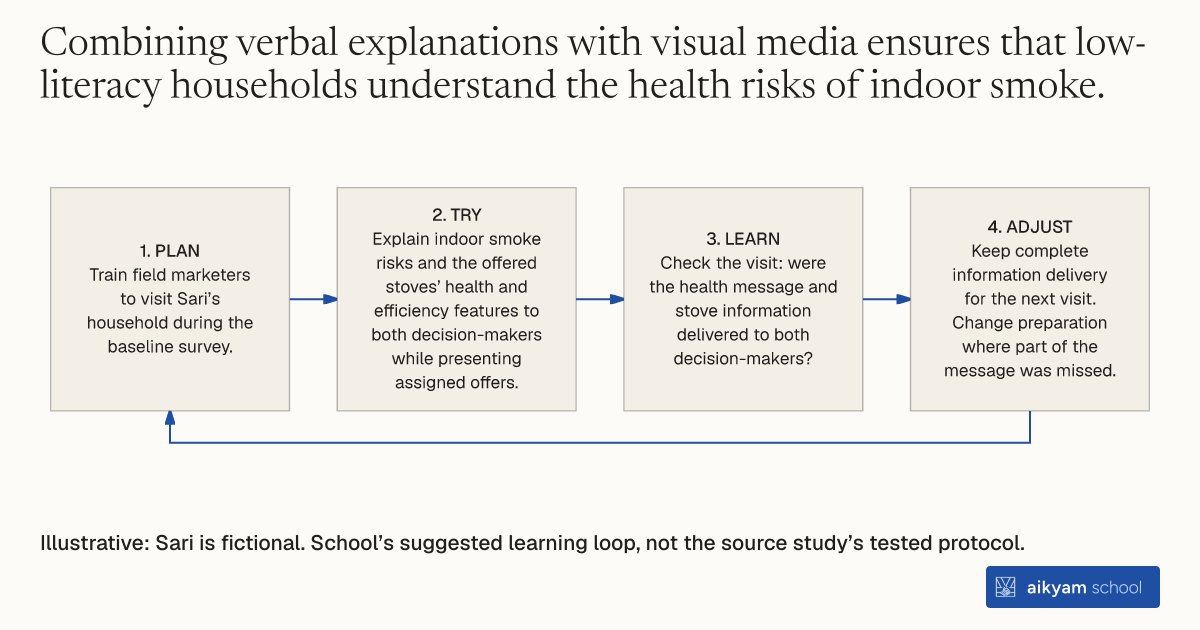
- Plan: Train field marketers to visit Sari’s household during the baseline survey.
- Try: Explain indoor smoke risks and the offered stoves’ health and efficiency features to both decision-makers while presenting assigned offers.
- Learn: Check the visit: were the health message and stove information delivered to both decision-makers?
- Adjust: Keep complete information delivery for the next visit. Change preparation where part of the message was missed.
Illustrative: Sari is fictional. School’s suggested learning loop, not the source study’s tested protocol.
See source →School’s suggested, untested loop. Observe information delivery and stove offers. Low full-price adoption in the study does not establish an education effect.
How
When to use
Public health programs aim to raise awareness about indoor air pollution hazards among rural households. Lack of knowledge about smoke risks is believed to prevent families from adopting clean cooking options. A multimedia health education campaign delivers structured information about smoke hazards and cookstove benefits directly to households.
Deliver a multimedia health education campaign to rural households before presenting clean cooking products.
- Train field marketers to visit targeted rural households during baseline survey activities.
- Present a multimedia health education message detailing the health risks of indoor air pollution from traditional cookstoves.
- Explain the specific health and efficiency benefits of the offered nontraditional cookstoves to both household decision-makers.
- Distribute information while offering assigned cookstove technologies at specified test prices.
Why it works
Providing information directly to both spouses aligns household understanding prior to technology purchase decisions.
Example
Field teams delivered a multimedia health education campaign to 2,280 households across 42 villages in Hatiya and Jamalpur, Bangladesh, in 2008. Despite receiving health education, full-price cookstove adoption remained at 2% for chimney stoves and 5% for efficiency stoves.
About the study
Participants
2,280 households across 42 rural villages in Hatiya and Jamalpur, Bangladesh.
Study Design
Universal health education campaign delivered during baseline survey visits across 42 cluster-randomized trial villages between July and September 2008.
Results
Universal exposure to health education resulted in negligible full-price adoption rates of 2% for chimney cookstoves and 5% for efficiency cookstoves.