Research steps
Elicit choices for the next six study days
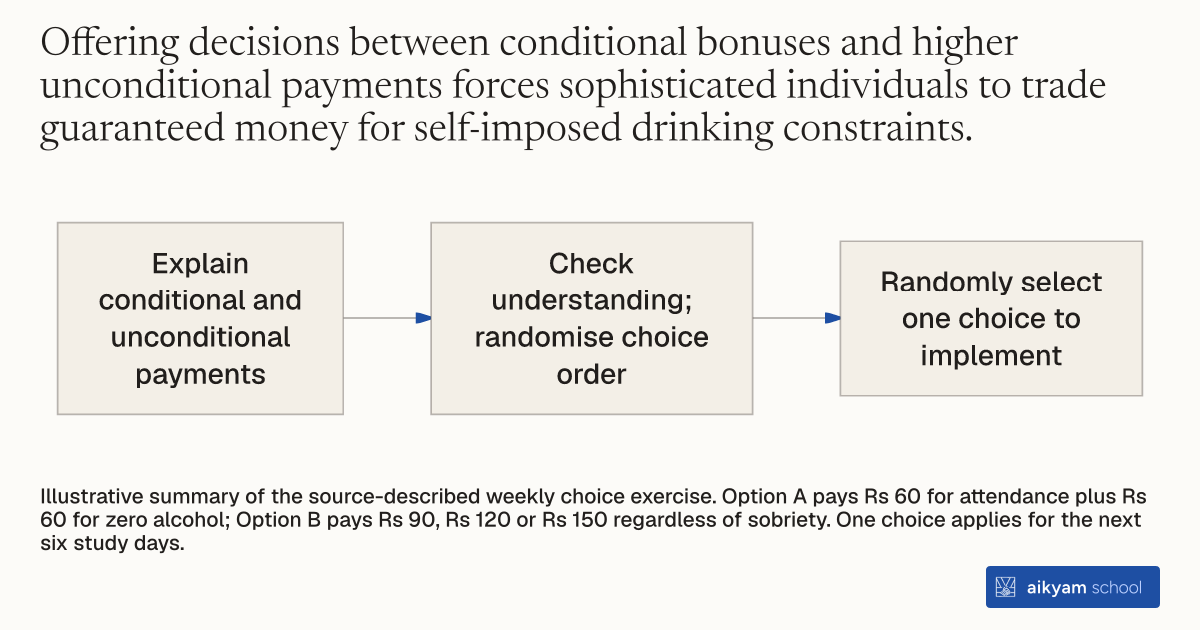
- Explain conditional and unconditional payments
- Check understanding; randomise choice order
- Randomly select one choice to implement
Illustrative summary of the source-described weekly choice exercise. Option A pays Rs 60 for attendance plus Rs 60 for zero alcohol; Option B pays Rs 90, Rs 120 or Rs 150 regardless of sobriety. One choice applies for the next six study days.
See source →How
When to use
Researchers and policymakers lack methods to measure individuals' willingness to pay for commitment to overcome self-control problems regarding alcohol. Standard market offers do not allow individuals to voluntarily trade off monetary rewards for sobriety constraints. Use this method to elicit demand for commitment by offering choices between conditional sobriety bonuses and varying levels of unconditional payments.
Administer a multiple price list exercise offering weekly choices between conditional sobriety incentives and varying unconditional payment amounts to measure demand for commitment.
- Surveyors explain Option A, which pays a base amount of Rs 60 for attending an evening office visit plus a Rs 60 bonus if breathalyzer testing shows zero alcohol.
- Surveyors present three distinct choices pairing Option A against Option B unconditional payments of Rs 90, Rs 120, and Rs 150 regardless of sobriety.
- Surveyors review comprehension with participants and clarify that choosing Option A over Rs 120 or Rs 150 implies sacrificing guaranteed income for sobriety incentives.
- Surveyors randomize the presentation order of choices across participants to control for order and anchoring effects.
- Surveyors inform participants that one choice will be randomly selected and implemented for the subsequent six study days to ensure incentive compatibility.
Why it works
Implementing a randomly selected choice ensures that participants state their true preferences rather than answering hypothetically.
Example
In Chennai, cycle-rickshaw drivers completed weekly price list choices between sobriety incentives (Option A: Rs 60 if drunk, Rs 120 if sober) and unconditional payments (Option B: Rs 90, Rs 120, or Rs 150). Over half of participants chose Option A over Rs 120 unconditional payment, exhibiting weak demand for commitment, while about one-third chose Option A over Rs 150 unconditional payment, sacrificing 10 to 30 percent of daily labor earnings to commit to sobriety.
About the study
Participants
229 male cycle-rickshaw drivers aged 25 to 60 in Chennai, India.
Study Design
Incentive-compatible multiple price list choice experiment with randomized implementation administered on days 7, 13, and 20.
Results
Over one-half of participants chose sobriety incentives when weakly dominated (over Rs 120 unconditional), and over one-third chose sobriety incentives when strictly dominated (over Rs 150 unconditional), giving up Rs 30 to Rs 90 per day.