Research steps
Track work take-up across two rounds
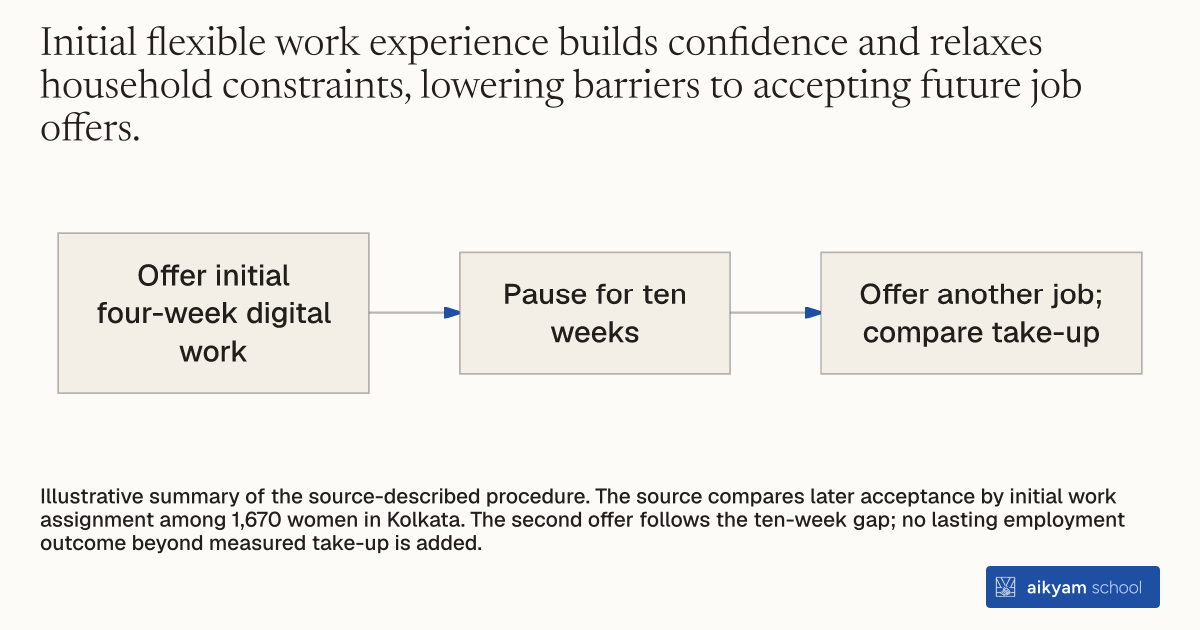
- Offer initial four-week digital work
- Pause for ten weeks
- Offer another job; compare take-up
Illustrative summary of the source-described procedure. The source compares later acceptance by initial work assignment among 1,670 women in Kolkata. The second offer follows the ten-week gap; no lasting employment outcome beyond measured take-up is added.
See source →How
When to use
Many women face initial social and psychological barriers that prevent them from entering the labor force. Sequential multi-round work exposure offers an initial flexible employment phase followed by a subsequent job offer weeks later. This method serves labor market programs seeking to build long-term female employment persistence through stepping-stone job opportunities.
Provide sequential employment opportunities across distinct time rounds to build labor market familiarity and encourage repeat job take-up.
- Recruit participants and assign them to an initial four-week digital gig work round.
- Monitor participant labor supply, completed micro-tasks, and overall earnings during the first work round.
- Pause employment activities for a ten-week interval to observe intra-household norm changes and retention.
- Issue a second job offer to participants ten weeks after the initial work round concludes.
- Track participant job offer acceptance rates and compare take-up between previously flexible and non-flexible workers.
Why it works
Gradual exposure transforms flexible gig work into a stepping stone toward sustained labor market participation.
Example
In Kolkata, West Bengal, India, researchers offered a second job ten weeks after an initial four-week gig work period to 1,670 women, finding that those previously assigned to flexible work were 6 percentage points more likely to accept the new job offer.
About the study
Participants
1,670 women (average age 30, 93% married, 69% never previously worked for pay) in Kolkata, West Bengal, India.
Study Design
Two-round longitudinal RCT with a ten-week pause between rounds to evaluate stepping-stone effects and repeat job take-up across initial work treatment arms.
Results
Assignment to a flexible job in round one increased job offer acceptance ten weeks later by 6 percentage points compared to women not previously assigned to a flexible job.