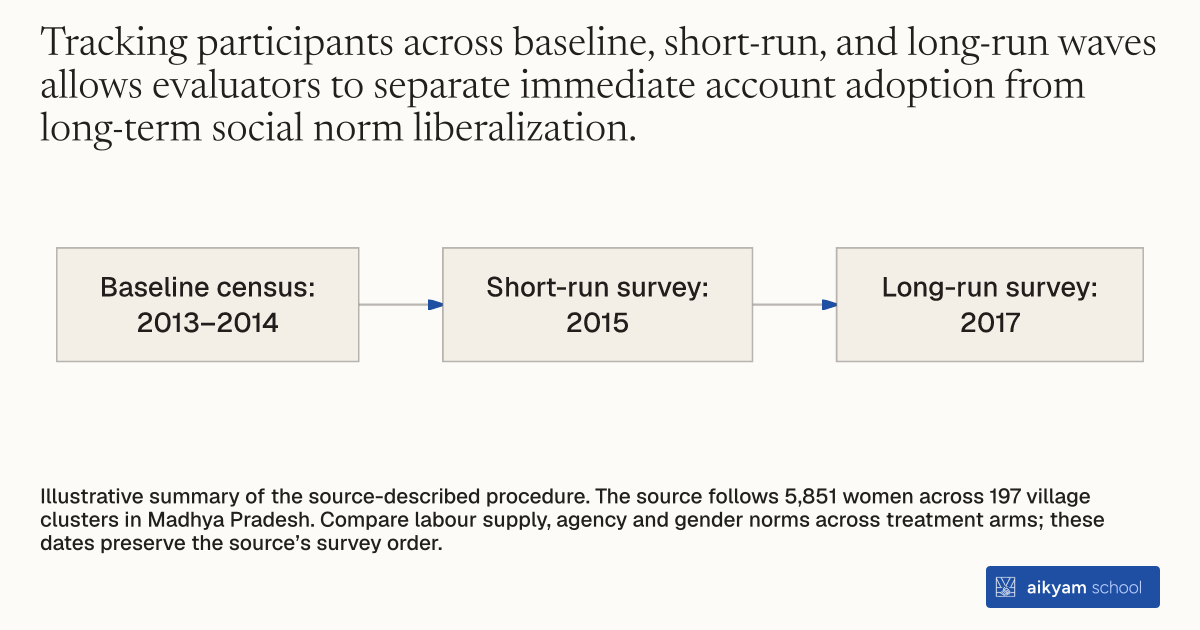
Research steps
Track employment and gender norms
- Baseline census: 2013–2014
- Short-run survey: 2015
- Long-run survey: 2017
Illustrative summary of the source-described procedure. The source follows 5,851 women across 197 village clusters in Madhya Pradesh. Compare labour supply, agency and gender norms across treatment arms; these dates preserve the source’s survey order.
See source →How
When to use
Evaluating long-term behavioral and norm shifts from economic development interventions requires tracking participants over multiple years. Short-term surveys often fail to capture sustained changes in social norms or labor force participation. This method serves researchers and policy evaluators evaluating gender empowerment programs.
Conduct longitudinal survey rounds across targeted village clusters to measure individual agency, employment, and community gender norms over time.
- Field researchers administer a baseline census across sample village households to collect demographic and labor data.
- Survey teams conduct a short-run follow-up survey one year after intervention launch to capture immediate behavioral changes.
- Field staff execute a comprehensive long-run survey three years post-intervention to measure persistent effects.
- Data analysts compare outcomes across treatment arms to quantify shifts in female labor supply and gender norm indices.
Why it works
Repeated surveying provides precise empirical data on whether economic agency generates lasting shifts in community attitudes.
Example
In Madhya Pradesh, India, researchers conducted baseline census surveys in 2013–2014, short-run surveys in 2015, and long-run surveys in 2017 across 197 village clusters to measure long-term financial autonomy and norm shifts.
About the study
Participants
5,851 women in 197 gram panchayats across Gwalior, Morena, Shivpuri, and Sheopur districts in Madhya Pradesh, India.
Study Design
Longitudinal randomized controlled trial evaluating survey data collected at baseline (2013–2014), short-run (2015), and long-run (2017) follow-up rounds.
Results
Surveying revealed that assignment to full treatment increased the female banking autonomy index by 0.12 standard deviations and liberalized perceived gender norms by 0.08–0.09 standard deviations three years after implementation.