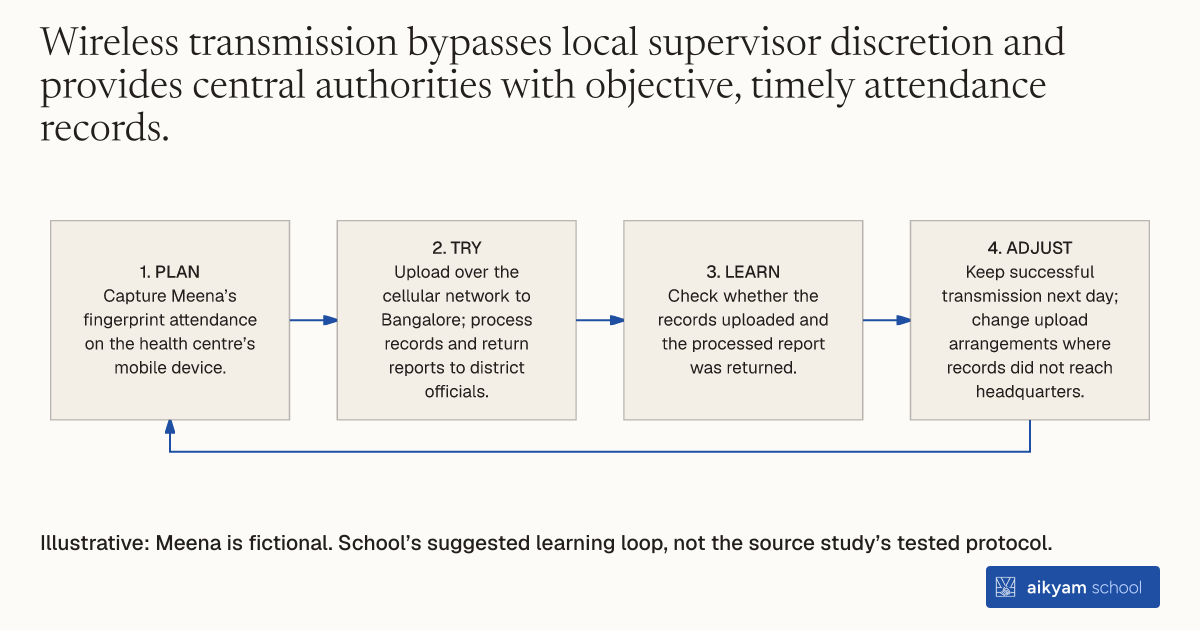
Try, learn and adjust
Check attendance reports reach district officials
- Plan: Capture Meena’s fingerprint attendance on the health centre’s mobile device.
- Try: Upload over the cellular network to Bangalore; process records and return reports to district officials.
- Learn: Check whether the records uploaded and the processed report was returned.
- Adjust: Keep successful transmission next day; change upload arrangements where records did not reach headquarters.
Illustrative: Meena is fictional. School’s suggested learning loop, not the source study’s tested protocol.
See source →School’s suggested learning loop: Observe uploads, processing and district reports. Data transmission alone does not establish attendance gains.
How
When to use
In public health systems, paper attendance logs allow local supervisors to hide worker absences. Central health authorities cannot monitor health center operations without timely attendance records. This method transmits health worker attendance data wirelessly using cellular networks to state headquarters in near real time.
Transmit daily biometric attendance records from primary health centers to central supervisors using cellular networks.
- Capture staff attendance data on a fingerprint reader connected to a multi-purpose mobile phone at primary health centers.
- Upload the attendance data wirelessly to state health headquarters in Bangalore over the existing cellular network.
- Process and analyze the uploaded attendance records at state health headquarters.
- Communicate processed attendance reports back to district health officials to enable monitoring.
Why it works
Real-time reporting makes attendance visible to senior officials and enables state-wide monitoring of health center operations.
Example
The Government of Karnataka deployed cellular-enabled devices across 140 primary health centers, where 67 percent of health centers successfully uploaded attendance data to the state government on any given day.
About the study
Participants
322 primary health centers across five socio-economically diverse districts in Karnataka, India, covering healthcare providers including doctors, nurses, lab technicians, and pharmacists.
Study Design
Randomized controlled trial comparing 140 health centers equipped with wireless biometric monitoring devices against 182 health centers continuing with paper logbooks.
Results
Sixty-seven percent of health centers uploaded attendance data to state headquarters the day before random checks, matching the 66 percent proportion of devices found in working order. Medical staff attendance increased by 5.5 percentage points (15 percent) from a 37 percent baseline in comparison clinics, while USAID estimated the overall program generated 17 US dollars in social benefit for every 1 US dollar spent.