Try, learn and adjust
Check mobile patient reporting
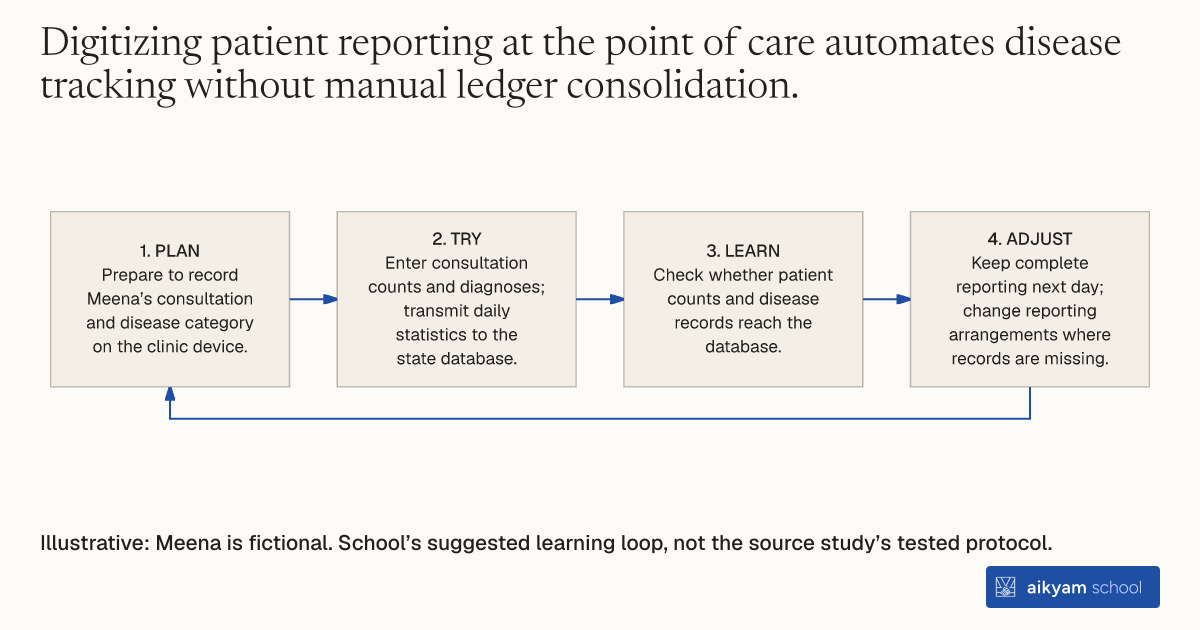
- Plan: Prepare to record Meena’s consultation and disease category on the clinic device.
- Try: Enter consultation counts and diagnoses; transmit daily statistics to the state database.
- Learn: Check whether patient counts and disease records reach the database.
- Adjust: Keep complete reporting next day; change reporting arrangements where records are missing.
Illustrative: Meena is fictional. School’s suggested learning loop, not the source study’s tested protocol.
See source →School’s suggested learning loop: Observe consultation counts, disease categories and transmission. Clinics rarely used this feature in the trial; no surveillance benefit is inferred.
How
When to use
Public health authorities lack real-time epidemiological data on diseases treated in rural clinics. Delayed reporting in paper ledgers hinders rapid response to disease outbreaks. This method uses mobile health devices in primary health centers to record patient volume and disease incidence.
Record patient visits and treated diseases on health center mobile devices to generate digital health statistics.
- Examine arriving patients at the primary health center during daily medical consultations.
- Enter patient consultation numbers into the multi-purpose mobile health device at the health center.
- Record diagnostic codes and disease categories treated for each patient on the mobile interface.
- Transmit daily disease surveillance statistics electronically to state health databases.
Why it works
Immediate central data collection allows health administrators to track disease outbreaks across public health centers.
Example
The Government of Karnataka deployed mobile devices capable of recording patient statistics and treated diseases across 140 primary health centers in 2010, though clinics primarily focused usage on staff attendance monitoring.
About the study
Participants
322 primary health centers across five socio-economically diverse districts in Karnataka, India, covering healthcare staff and visiting patients.
Study Design
Randomized controlled trial comparing 140 health centers equipped with mobile disease reporting devices against 182 health centers maintaining status quo paper records.
Results
Primary health centers rarely utilized the secondary disease surveillance tracking feature, focusing device usage almost entirely on staff attendance tracking. Medical staff attendance increased by 5.5 percentage points (15 percent) from a 37 percent baseline, leading to a 26 percent reduction in low-birth-weight infants.