Try, learn and adjust
Check cash benefit verification records
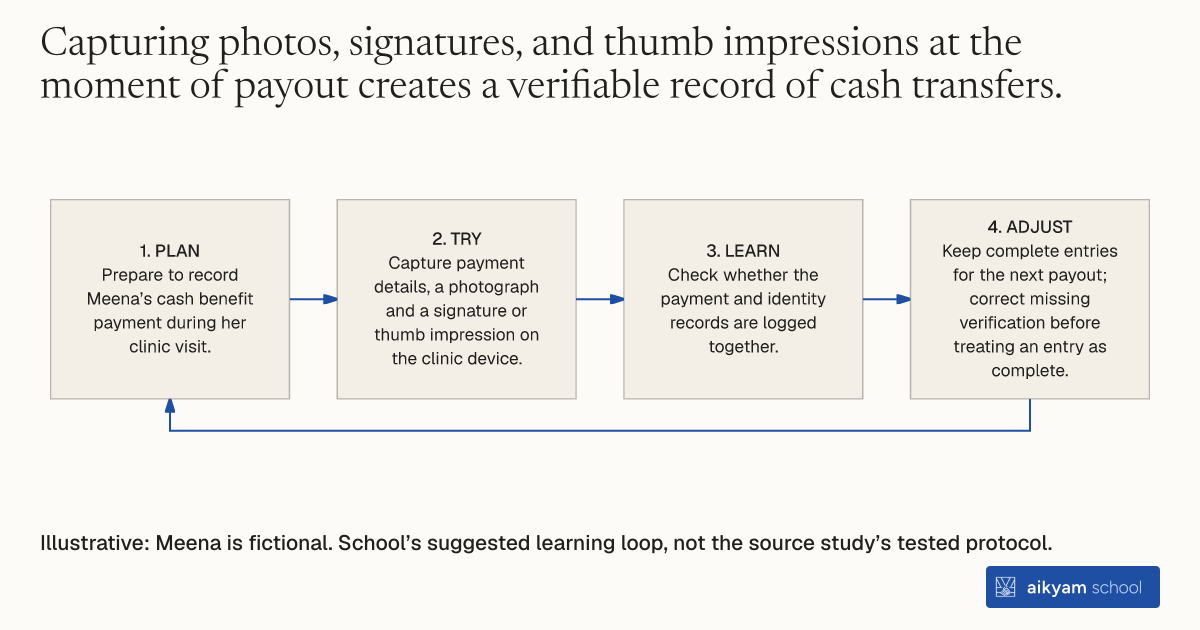
- Plan: Prepare to record Meena’s cash benefit payment during her clinic visit.
- Try: Capture payment details, a photograph and a signature or thumb impression on the clinic device.
- Learn: Check whether the payment and identity records are logged together.
- Adjust: Keep complete entries for the next payout; correct missing verification before treating an entry as complete.
Illustrative: Meena is fictional. School’s suggested learning loop, not the source study’s tested protocol.
See source →School’s suggested learning loop: Observe payment and verification records. Clinics rarely used this feature in the trial; the loop does not establish reduced leakage.
How
When to use
Public health systems often suffer from entitlement leakages where cash benefits intended for patients are misallocated or stolen. Paper distribution logs lack reliable verification of patient identity and actual receipt of funds. This method records digital beneficiary details, photos, and biometric signatures at primary health centers to track cash disbursements.
Record digital beneficiary photos and biometric verification on clinic mobile devices when disbursing cash benefits.
- Collect cash benefit payment details at the primary health center during patient visits.
- Capture a photograph of the patient receiving cash benefits using the clinic's mobile device.
- Obtain the patient's signature or thumb impression on the device to verify identity.
- Log the payment details and verification records in the multi-purpose monitoring system.
Why it works
Digital verification reduces fraudulent claims and prevents local administrators from leaking government entitlement funds.
Example
The Government of Karnataka introduced cash benefit tracking capabilities on mobile devices across 140 primary health centers in 2010 to address entitlement leakages, though clinics primarily utilized the system for attendance monitoring.
About the study
Participants
322 primary health centers across five socio-economically diverse districts in Karnataka, India, covering health center operations and patient care.
Study Design
Randomized controlled trial comparing 140 health centers equipped with digital cash tracking devices against 182 health centers maintaining paper records.
Results
Primary health centers rarely used the secondary cash benefit tracking capability and focused usage almost entirely on attendance tracking. Pregnant women in treatment areas were 7 percent less likely to know about state entitlements for subsidized care and paid higher out-of-pocket prices for child delivery.