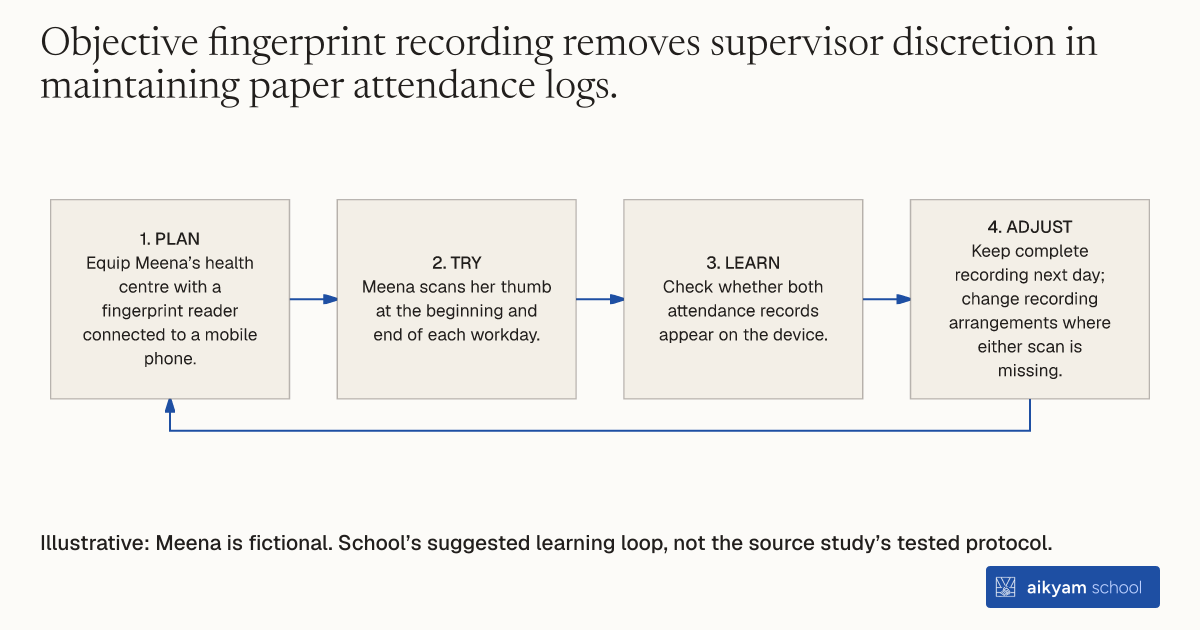
Try, learn and adjust
Check daily fingerprint attendance records
- Plan: Equip Meena’s health centre with a fingerprint reader connected to a mobile phone.
- Try: Meena scans her thumb at the beginning and end of each workday.
- Learn: Check whether both attendance records appear on the device.
- Adjust: Keep complete recording next day; change recording arrangements where either scan is missing.
Illustrative: Meena is fictional. School’s suggested learning loop, not the source study’s tested protocol.
See source →School’s suggested learning loop: Observe beginning- and end-of-day records. The suggested loop does not establish changes in attendance or birth outcomes.
How
When to use
Public primary health centers face high rates of staff absenteeism that weaken healthcare delivery. Paper logbooks allow discretion by local supervisors and fail to ensure accountability. This method tracks daily presence for public health care workers using biometric fingerprint devices.
Track health center staff attendance using fingerprint readers connected to mobile phones.
- Equip primary health centers with monitoring devices consisting of a fingerprint reader connected to a mobile phone.
- Require healthcare workers to scan their thumb impression on the fingerprint reader at the beginning of each workday.
- Require healthcare workers to scan their thumb impression on the fingerprint reader at the end of each workday.
- Record staff attendance records directly on the connected device.
Why it works
Visible attendance tracking increases the social stigma cost of being absent for non-doctor medical staff.
Example
The Government of Karnataka installed fingerprint monitoring devices in 140 primary health centers across five districts in 2010, which increased non-doctor medical staff attendance by 7 percentage points from a base of 40 percent.
About the study
Participants
322 primary health centers across five socio-economically diverse districts in Karnataka, India, covering healthcare providers including doctors, nurses, lab technicians, and pharmacists.
Study Design
Randomized controlled trial comparing 140 health centers equipped with biometric attendance devices against 182 health centers continuing with paper logbooks.
Results
Medical staff attendance increased by 5.5 percentage points (15 percent) from a base of 37 percent in comparison health centers, with attendance for nurses, lab technicians, and pharmacists increasing by 7 percentage points from a base of 40 percent. Newborns in treatment areas were 4.6 percentage points (26 percent) less likely to be born underweight compared to 18 percent in the comparison group and weighed 67 grams more on average.