Research procedure
Link phone logs to survey participants
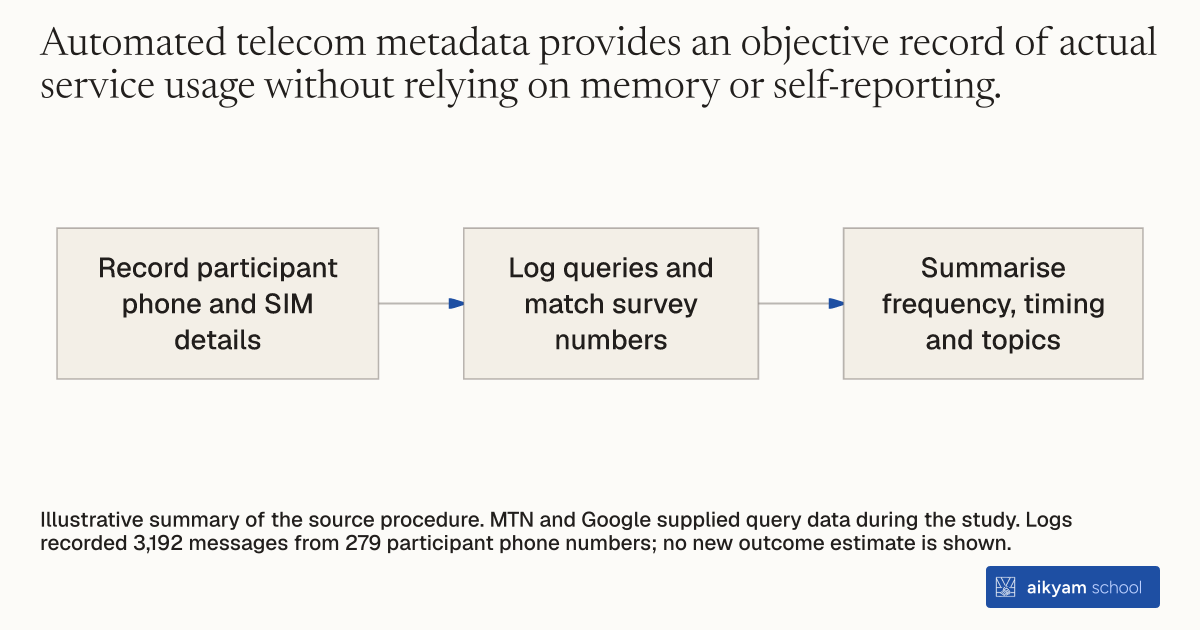
- Record participant phone and SIM details
- Log queries and match survey numbers
- Summarise frequency, timing and topics
Illustrative summary of the source procedure. MTN and Google supplied query data during the study. Logs recorded 3,192 messages from 279 participant phone numbers; no new outcome estimate is shown.
See source →How
When to use
Evaluating digital health programs often relies on self-reported survey data, which suffers from recall errors and reporting bias. Researchers need objective measurements of user engagement and real-time service interaction. This method uses telecom network operator server logs to track user behavior automatically across study participants.
Track user engagement objectively by linking survey participants' phone numbers to automated network operator transaction logs.
- Survey enumerators record primary mobile phone numbers and SIM card details of study participants during field interviews.
- Mobile network operator engineers configure automated logging on central servers hosting short code 6001.
- Network servers record timestamped metadata for every incoming text query, including sender phone number and requested category.
- Evaluators cross-reference logged phone numbers against survey rosters to isolate participant activity.
- Data analysts compile usage frequency, timing, and topic distribution across trial treatment and control clusters.
Why it works
Linking system logs to study rosters allows evaluators to verify individual participation and track engagement trends over time.
Example
MTN Uganda recorded 3,192 text messages sent from 279 survey participant phone numbers to short code 6001 across 60 study villages, allowing researchers to measure exact daily messaging volume.
About the study
Participants
2,424 adults aged 18 to 35 with at least six years of primary education in 60 villages across Masaka, Mpigi, Mityana, and Mubende districts in central Uganda.
Study Design
Clustered encouragement-design RCT utilizing administrative telecom server metadata from MTN Uganda to measure objective participant texting frequency alongside self-reported surveys.
Results
Network metadata recorded 3,192 total messages sent from 279 participant phone numbers, showing a median of 4 text messages sent per user and revealing a sharp usage drop after marketing ended, with daily average messages falling to 4.0 in treatment villages and 1.5 in control villages.