Try, learn and adjust
Check farmer registration against shared eligibility rules
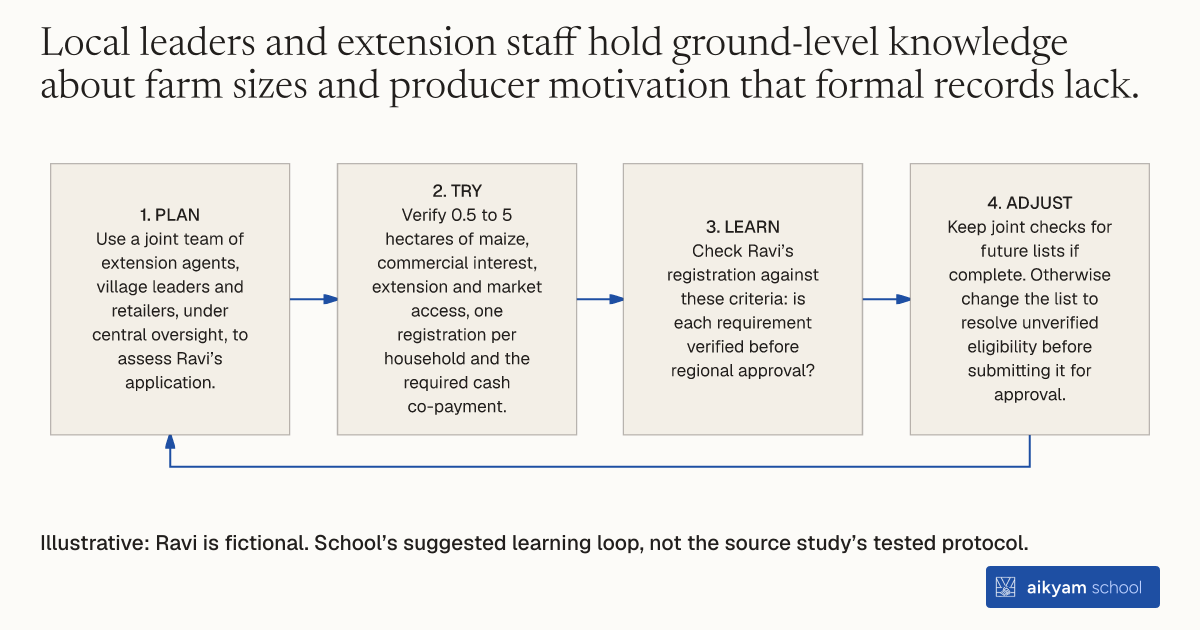
- Plan: Use a joint team of extension agents, village leaders and retailers, under central oversight, to assess Ravi’s application.
- Try: Verify 0.5 to 5 hectares of maize, commercial interest, extension and market access, one registration per household and the required cash co-payment.
- Learn: Check Ravi’s registration against these criteria: is each requirement verified before regional approval?
- Adjust: Keep joint checks for future lists if complete. Otherwise change the list to resolve unverified eligibility before submitting it for approval.
Illustrative: Ravi is fictional. School’s suggested learning loop, not the source study’s tested protocol.
See source →School’s suggested learning loop, not a source-tested procedure. Observe eligibility, single-household registration and co-payment readiness. The source describes verified lists of 1,593 household heads.
How
When to use
Agricultural development programs often lack official census data to identify eligible smallholders in remote rural areas. Program managers must screen for producers who have sufficient land and interest to adopt modern technology without giving subsidies to large commercial farms. This method identifies motivated smallholders who meet specific farm size and co-payment criteria.
Compile registration lists of eligible progressive smallholders through local stakeholder consensus and multi-party oversight.
- Define clear eligibility rules requiring farmers to cultivate between 0.5 and 5 hectares of maize and demonstrate interest in commercial farming.
- Form a joint local committee comprising agricultural extension agents, village leaders, and agro-input retailers under central supervisor oversight.
- Conduct village-level registration meetings where field staff verify farm size, extension access, and market connectivity for each applicant.
- Enforce a single registration per household and confirm that applicants possess the required cash co-payment prior to adding them to the list.
- Submit the finalized participant lists to regional government agriculture authorities for official administrative approval.
Why it works
Requiring joint approval across retailers, extension officers, and village authorities prevents individual local bias and limits registration fraud.
Example
In Manica Province, Mozambique, local extension agents, village leaders, and input retailers worked under IFDC supervision to register eligible maize farmers across 75 villages. The teams screened farmers cultivating 0.5 to 5 hectares of maize who were willing to contribute a 27% cash co-payment. The process created verified registration lists of 1,593 eligible household heads for the pilot program.
About the study
Participants
N = 1,593 small-scale maize farmers across 75 villages in Manica Province, Mozambique; sample household heads were 84% male, 76% literate, owned an average of 10.3 hectares of land, and cultivated an average of 3.57 hectares of maize.
Study Design
Randomized controlled trial comparing 795 voucher lottery winners against 798 voucher lottery losers selected from baseline multi-stakeholder registration lists.
Results
The multi-stakeholder screening targeted relatively progressive households, yielding a sample with 76% literacy compared to 45% regionally and 84% male heads compared to 66% regionally; 19% of selected farmers had previously used fertilizer on maize.