Research compliance
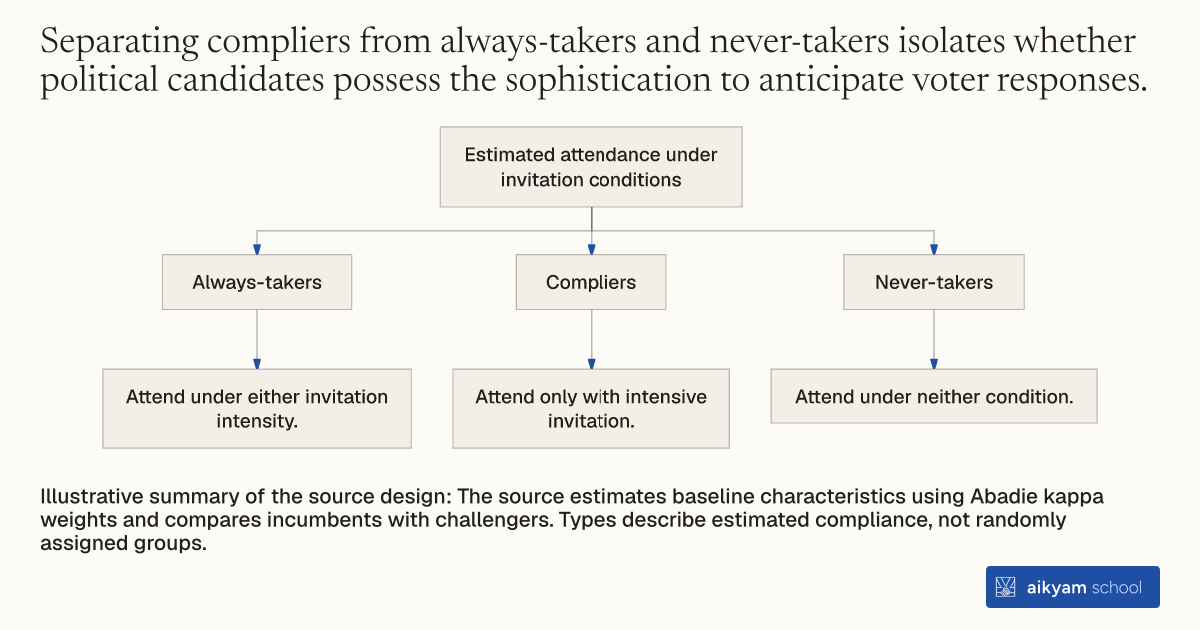
Classify debate participation types
Estimated attendance under invitation conditions
- Always-takers
- Attend under either invitation intensity.
- Compliers
- Attend only with intensive invitation.
- Never-takers
- Attend under neither condition.
Illustrative summary of the source design: The source estimates baseline characteristics using Abadie kappa weights and compares incumbents with challengers. Types describe estimated compliance, not randomly assigned groups.
See source →How
When to use
When evaluating public information campaigns, researchers often find that political candidates choose whether to participate based on expected electoral returns. Standard treatment effect estimates blur together who chooses to participate and how participation affects voters. This method categorizes candidates into compliance groups to evaluate how selection bias shapes program outcomes.
Analyze candidate compliance and selection into public debates by estimating baseline characteristics across candidate participation types.
- Categorize candidates into always-takers who attend debates regardless of invitation intensity, compliers who attend only when invited intensively, and never-takers who abstain under both conditions.
- Measure baseline candidate characteristics, including policy priority alignment with constituents, voter certainty regarding candidate policy positions, baseline competence assessments, and voter certainty regarding candidate competence.
- Compute kappa-weighted mean values of these baseline characteristics across compliers, always-takers, and never-takers following Abadie kappa weighting methods.
- Estimate non-parametric regressions of compliance status across baseline candidate characteristics to plot candidate participation probabilities.
- Compare compliance patterns between incumbents and challengers to determine whether political sophistication drives positive self-selection into debates.
Why it works
Comparing selection patterns across candidate types reveals whether program benefits stem from information delivery or differential candidate self-selection.
Example
Researchers evaluated candidate compliance across 984 legislative candidates in Liberia's 2017 House of Representatives election. The analysis showed that complying incumbents positively selected into debates when their policy priorities aligned with constituents, whereas complying challengers selected negatively on policy alignment.
About the study
Participants
984 legislative candidates across all 73 electoral districts in Liberia during the October 2017 election.
Study Design
Abadie kappa-weighted compliance analysis and non-parametric regressions estimating baseline characteristics across compliers, always-takers, and never-takers using baseline voter panel survey data and candidate survey data.
Results
Complier incumbents exhibited policy match z-scores of -0.22 compared to 0.60 for always-takers and -0.47 for never-takers; complier challengers exhibited policy match z-scores of -1.38 compared to 0.17 for always-takers and 0.14 for never-takers; 50 percent of incumbents in treated districts won re-election compared to 43 percent in control districts.