Research analysis
Compare changes across municipalities
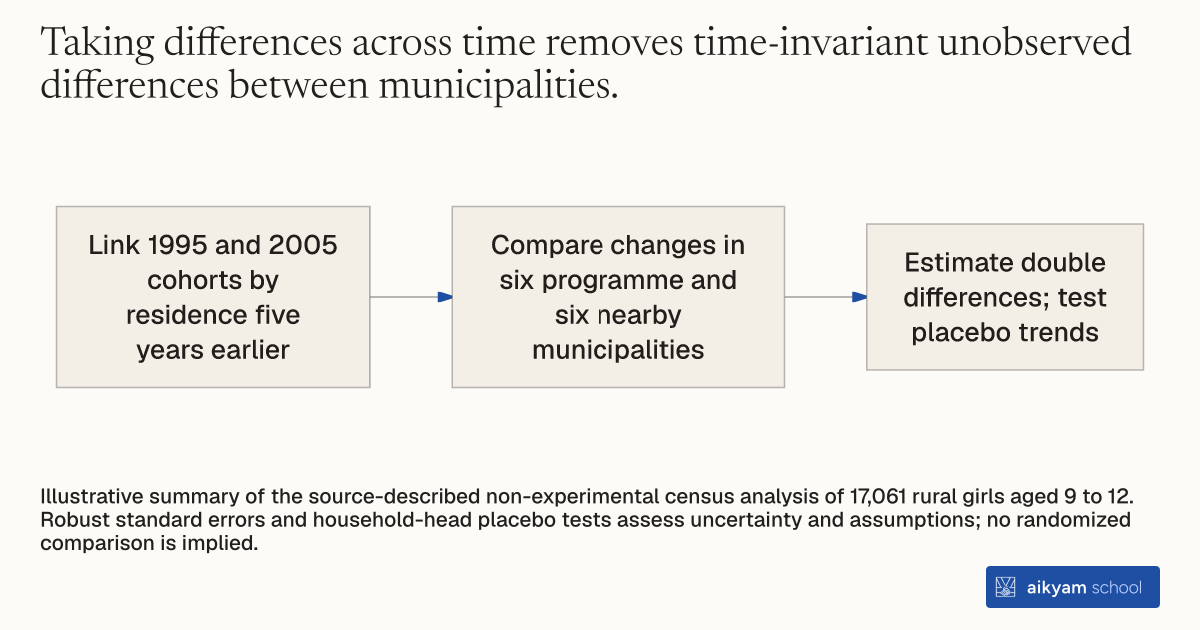
- Link 1995 and 2005 cohorts by residence five years earlier
- Compare changes in six programme and six nearby municipalities
- Estimate double differences; test placebo trends
Illustrative summary of the source-described non-experimental census analysis of 17,061 rural girls aged 9 to 12. Robust standard errors and household-head placebo tests assess uncertainty and assumptions; no randomized comparison is implied.
See source →How
When to use
Evaluators face challenges measuring absolute long-term impacts when social protection programs scale up across all target communities and eliminate experimental control groups. Double difference estimation using repeated national population censuses provides a non-experimental counterfactual. This method enables researchers to assess overall program effects while controlling for domestic migration.
Estimate non-experimental absolute program impacts by comparing pre-program and post-program cohort outcomes from repeated national population censuses between program and comparison municipalities.
- Evaluators extract individual demographic, educational, and fertility records for target age cohorts from national population censuses conducted before program launch and after program completion.
- Evaluators assign each individual to their municipality of residence five years prior to each census date to adjust for domestic migration.
- Evaluators define treatment indicators for individuals residing in municipalities where social protection programs achieved near-universal coverage.
- Evaluators select comparison cohorts from adjacent rural municipalities sharing similar baseline poverty and marginality levels.
- Evaluators calculate the double difference estimator by subtracting changes over time in comparison municipalities from changes in treatment municipalities.
- Evaluators estimate robust standard errors and test the common trends assumption using unaffected placebo groups such as household heads.
Why it works
Reconstructing residency five years prior prevents migration-driven selection bias from distorting impact estimates.
Example
In Nicaragua, researchers evaluated the 5-year absolute impact of the Red de Protección Social CCT program using national censuses from 1995 and 2005. Comparing 17,061 rural girls aged 9 to 12 in program municipalities against adjacent comparison municipalities revealed an absolute increase of 0.54 completed grades, an 11 percentage point increase in fourth-grade completion, and a 2 percentage point reduction in early pregnancy.
About the study
Participants
17,061 rural girls aged 9 to 12 across six program municipalities and six comparison municipalities in central and northern Nicaragua.
Study Design
Non-experimental double difference specification comparing individual-level 1995 pre-program and 2005 post-program census records between treatment and comparison municipalities based on residency five years prior.
Results
Five years of program coverage increased primary school grades completed by 0.536 grades, increased fourth-grade completion by 10.5 percentage points, increased literacy by 6.6 percentage points, and reduced early pregnancy by 2.3 percentage points.