Research procedure
Deliver a nonpolitical comparison call
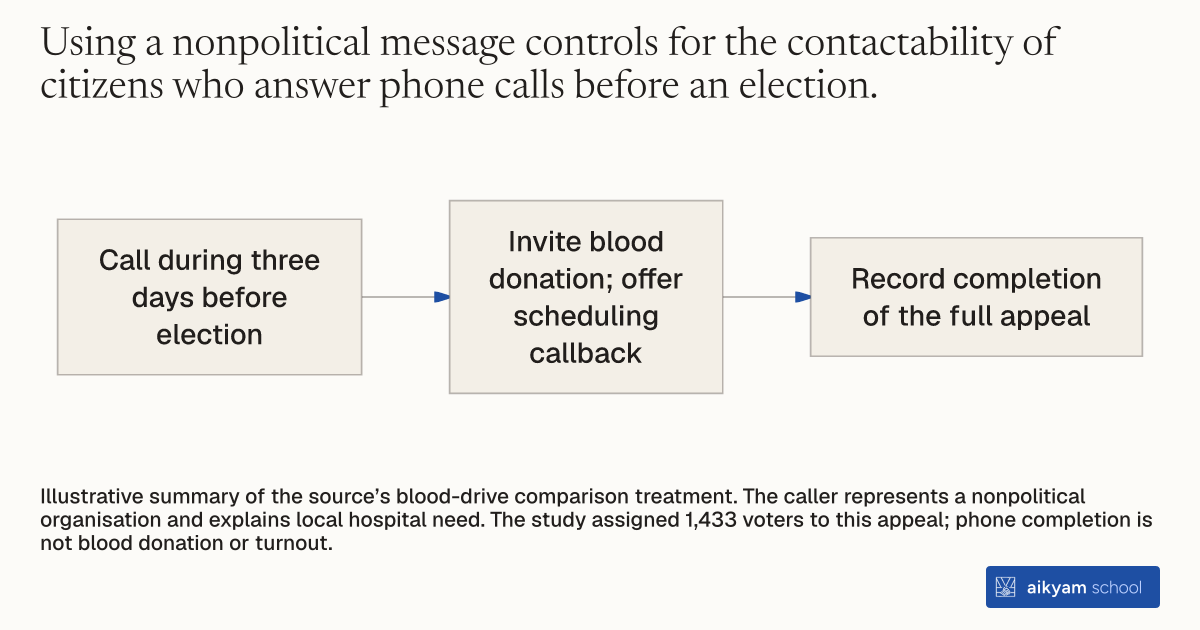
- Call during three days before election
- Invite blood donation; offer scheduling callback
- Record completion of the full appeal
Illustrative summary of the source’s blood-drive comparison treatment. The caller represents a nonpolitical organisation and explains local hospital need. The study assigned 1,433 voters to this appeal; phone completion is not blood donation or turnout.
See source →How
When to use
An organization needs to test whether mobilization effects stem from political message content or merely from successful contact. Delivering a nonpolitical, civic-oriented phone call provides an active benchmark to isolate contactability from campaign messaging.
Place a nonpolitical civic telephone appeal inviting registered voters to participate in a local blood drive.
- Contract a telemarketing firm to place calls during the three days leading up to an election.
- Identify the caller as representing a nonpolitical community organization such as the American Red Cross.
- Invite the voter to donate blood at an upcoming blood drive in their community.
- Explain that volunteer blood donors are needed to support patients in local hospitals.
- Ask whether a local representative can call back to schedule a donation appointment.
- Record whether the targeted voter completes the full phone appeal.
Why it works
Comparing political appeals against nonpolitical appeals isolates the specific impact of civic messaging from the general effect of receiving phone contact.
Example
In West Haven, Connecticut, prior to the 1998 general election, callers attempted to reach 1,433 registered voters with an invitation to donate blood to the American Red Cross. Callers successfully reached 631 voters, and those contacted turned out at 67.8 percent compared to 43.5 percent among uncontacted voters in the group, resulting in an estimated treatment effect of 1.6 percentage points (SE = 3.3).
About the study
Participants
1,433 registered voters assigned to receive the blood donation call out of 17,100 total registered voters in West Haven, CT, during the 1998 general election.
Study Design
Randomized controlled trial comparing turnout rates among voters assigned a nonpolitical blood drive appeal against political GOTV message groups and a 6,843-voter control group.
Results
Overall turnout for the blood drive assignment group was 54.2 percent with a contact rate of 44.0 percent; the estimated treatment effect was 1.6 percentage points (SE = 3.3), demonstrating no statistically significant difference in turnout between political and nonpolitical messages.