Research procedure
Observe choices over payment control
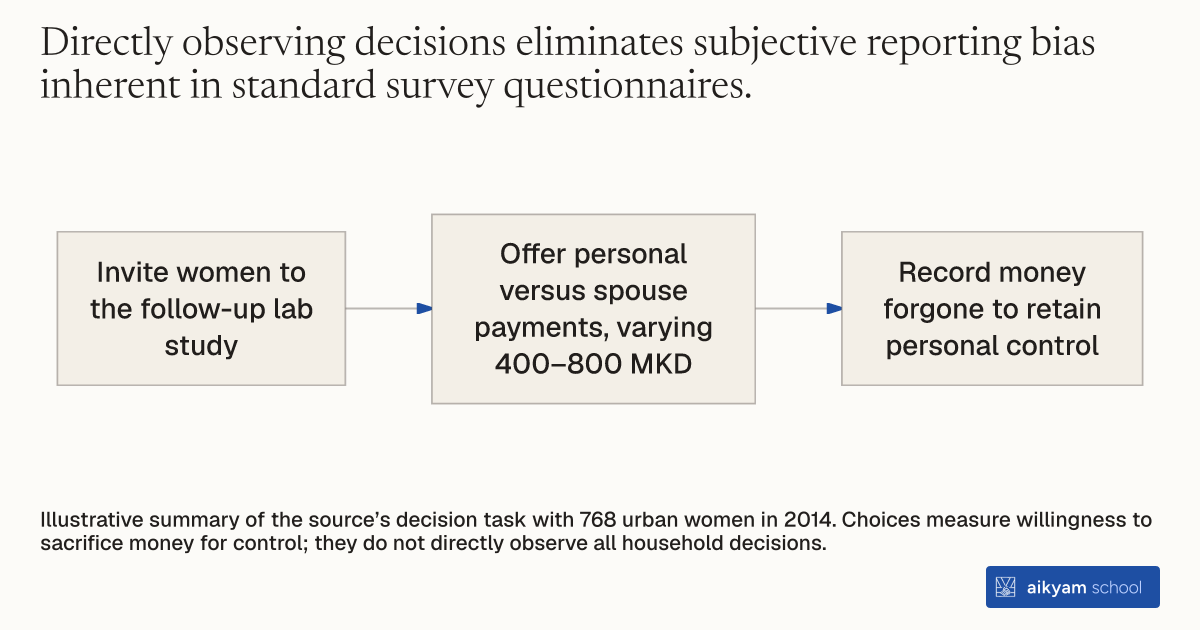
- Invite women to the follow-up lab study
- Offer personal versus spouse payments, varying 400–800 MKD
- Record money forgone to retain personal control
Illustrative summary of the source’s decision task with 768 urban women in 2014. Choices measure willingness to sacrifice money for control; they do not directly observe all household decisions.
See source →How
When to use
Researchers need to measure female empowerment and decision-making power inside households. Traditional survey questionnaires often fail to capture context-specific dynamics of intrahousehold control accurately. Observing actual choices in a lab task reveals a woman's true willingness to forego household funds to maintain direct control over money.
Measure intrahousehold bargaining power by offering participants a structured sequence of financial choices between direct personal payments and larger payments given to their spouse.
- Invite female participants to a lab study following a cash transfer intervention.
- Offer each woman a cash transfer payment alongside options to keep the money or pass it to her husband.
- Present a series of decisions where the woman chooses between a full payout given to her spouse or a reduced payout given directly to her.
- Vary the trade-off amounts across rounds, ranging from 400 MKD to 800 MKD.
- Record the exact amount of cash a woman is willing to sacrifice to retain personal control over the disbursement.
Why it works
A participant's willingness to sacrifice total household income directly reflects her implicit lack of control or authority over funds controlled by her spouse.
Example
In a 2014 follow-up study in North Macedonia, researchers tested 768 urban women using this decision task. Participants were willing to sacrifice an average of 19 percent of the payment to receive funds directly, but women who received targeted conditional cash transfers sacrificed 5.3 percentage points less than women in households where husbands received transfers.
About the study
Participants
768 urban women in North Macedonia who participated in the first phase of the national cash transfer evaluation.
Study Design
A lab experiment conducted during a 2014 follow-up study offering a series of choices between spousal payouts and reduced individual payouts, followed by traditional empowerment surveys.
Results
Female CCT recipients sacrificed 5.3 percentage points less of the transfer amount (16 percent versus 22 percent) to retain control compared to non-recipient women, while 7 percent of women were willing to forfeit nearly the entire payment to prevent spousal receipt.