Try, learn and adjust
Check debates air unedited and on time
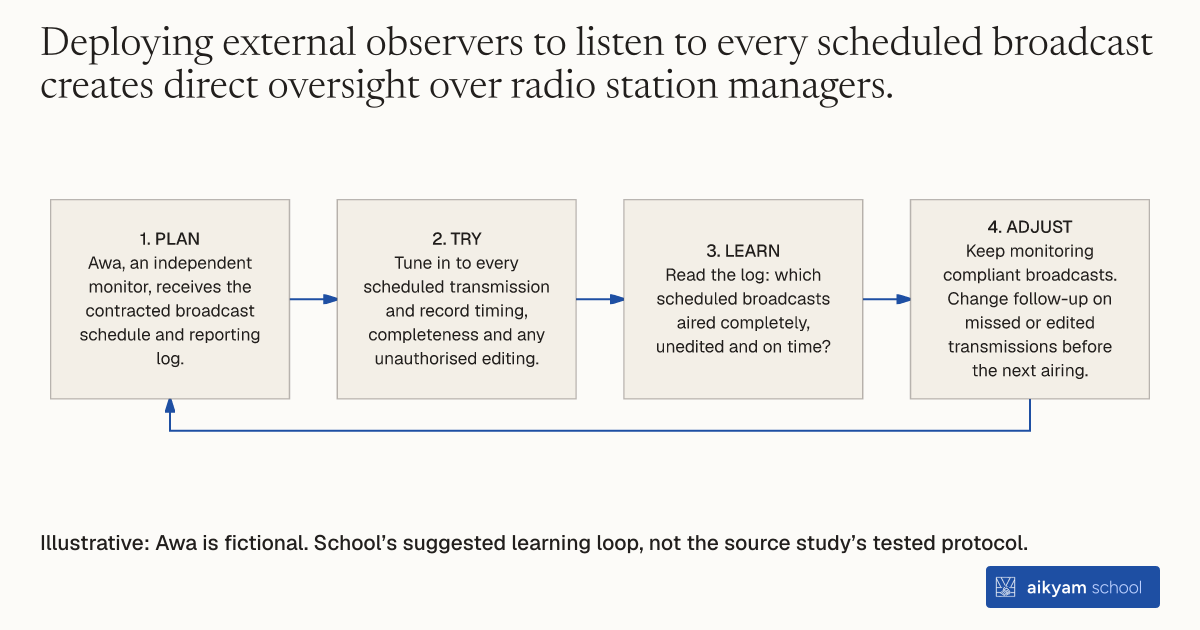
- Plan: Awa, an independent monitor, receives the contracted broadcast schedule and reporting log.
- Try: Tune in to every scheduled transmission and record timing, completeness and any unauthorised editing.
- Learn: Read the log: which scheduled broadcasts aired completely, unedited and on time?
- Adjust: Keep monitoring compliant broadcasts. Change follow-up on missed or edited transmissions before the next airing.
Illustrative: Awa is fictional. School’s suggested learning loop, not the source study’s tested protocol.
See source →School’s suggested learning loop: observe scheduled and actual broadcasts; transmission is not evidence that every resident listened.
How
When to use
When partnering with local radio stations to rebroadcast public interest programming during election campaigns, organizers face compliance risks if stations skip broadcasts or edit content for partisan reasons. Program directors need an objective verification system to ensure partner stations air unedited recordings on schedule. This approach deploys independent field observers to monitor every scheduled radio transmission.
Monitor partner radio stations to verify that scheduled political broadcasts air complete and unedited.
- Establish fixed rebroadcasting contracts and broadcast schedules with selected community radio stations.
- Hire independent local monitoring teams, such as youth organization representatives, across all targeted broadcast districts.
- Equip monitors with tuning equipment and standardized reporting logs to track station broadcasts.
- Instruct monitors to tune into every contracted transmission according to the scheduled air times.
- Record whether the broadcast aired on time, whether the audio played completely, and whether any unauthorized partisan editing occurred.
- Compile monitor reports into a compliance dataset to verify contract fulfillment and track actual audience reach.
Why it works
Verifying unedited transmissions prevents partisan media figures from suppressing or altering recorded candidate policy promises.
Example
Internews hired youth organization Naymote to monitor 43 partnering community radio stations across Liberia during the 2017 legislative election campaign. Independent monitors tuned into every scheduled candidate debate broadcast to verify that stations aired all 129 district debates unedited and on schedule.
About the study
Participants
43 partnering community radio stations across 73 electoral districts in Liberia during the 2017 House of Representatives election.
Study Design
Independent media compliance monitoring tracking scheduled debate transmissions across partnering stations alongside a post-election radio station survey.
Results
Monitors verified an average of 5.23 confirmed contracted rebroadcasts per district in control and 5.62 in treated districts, confirming that stations fulfilled broadcast contracts with no significant difference between treatment arms (-0.206 to 0.387 broadcast difference).