Research procedure
Nominate leaders across social domains
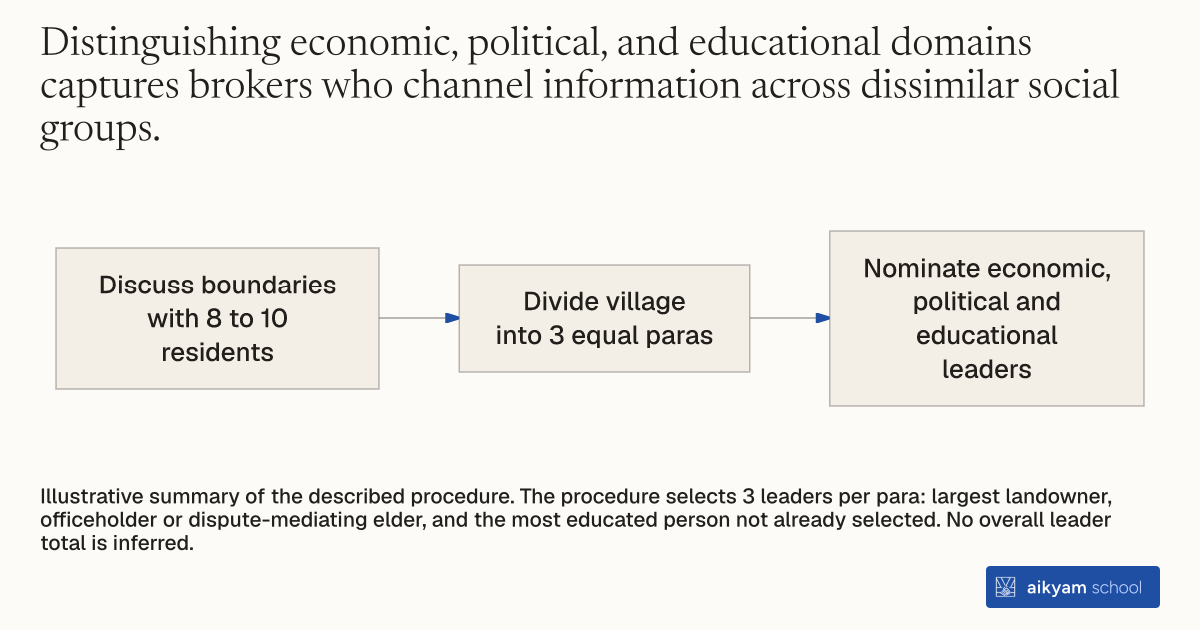
- Discuss boundaries with 8 to 10 residents
- Divide village into 3 equal paras
- Nominate economic, political and educational leaders
Illustrative summary of the described procedure. The procedure selects 3 leaders per para: largest landowner, officeholder or dispute-mediating elder, and the most educated person not already selected. No overall leader total is inferred.
See source →How
When to use
Development programs need to identify influential community members across distinct social domains to evaluate technology diffusion. Standard local leadership approaches often focus only on formal politicians, missing key economic or educational brokers. This method provides a structured participatory technique to select multi-dimensional social influencers in rural communities.
Identify local opinion leaders by facilitating village-level focus group discussions to nominate influential individuals across three distinct socio-cultural dimensions.
- Conduct one focus group discussion with 8 to 10 residents in each village to divide the village into 3 equal neighborhoods or paras.
- Ask villagers in each para to nominate an economic leader based on who owns the largest amount of land in the agrarian community.
- Ask villagers in each para to nominate a political leader who holds formal elected office or serves as an informal village elder mediating local disputes.
- Ask villagers in each para to nominate an educational leader representing the most educated person in the neighborhood not selected for economic or political leadership.
- Record 3 opinion leaders per para to sample 9 opinion leader households in each village alongside general household survey samples.
Why it works
Nominating local figures through community consensus ensures identified leaders reflect genuine neighborhood influence rather than administrative status.
Example
Researchers in 58 rural villages across Jamalpur Sadar and Hatia in Bangladesh conducted village focus group discussions to identify 180 opinion leaders across 3 paras per village.
About the study
Participants
180 opinion leader households and 2,900 general households across 58 villages in Jamalpur Sadar and Hatia upazilas, Bangladesh.
Study Design
Participatory nomination via 58 village-level focus group discussions (8 to 10 participants each) identifying 3 leaders per para across economic, political, and educational criteria.
Results
Selected 9 opinion leaders per village (3 per para) across 58 villages, enabling random assignment of opinion leader choice disclosure treatments to evaluate information transmission effects on cookstove adoption.