Try, learn and adjust
Check output-contract payments against outcome records
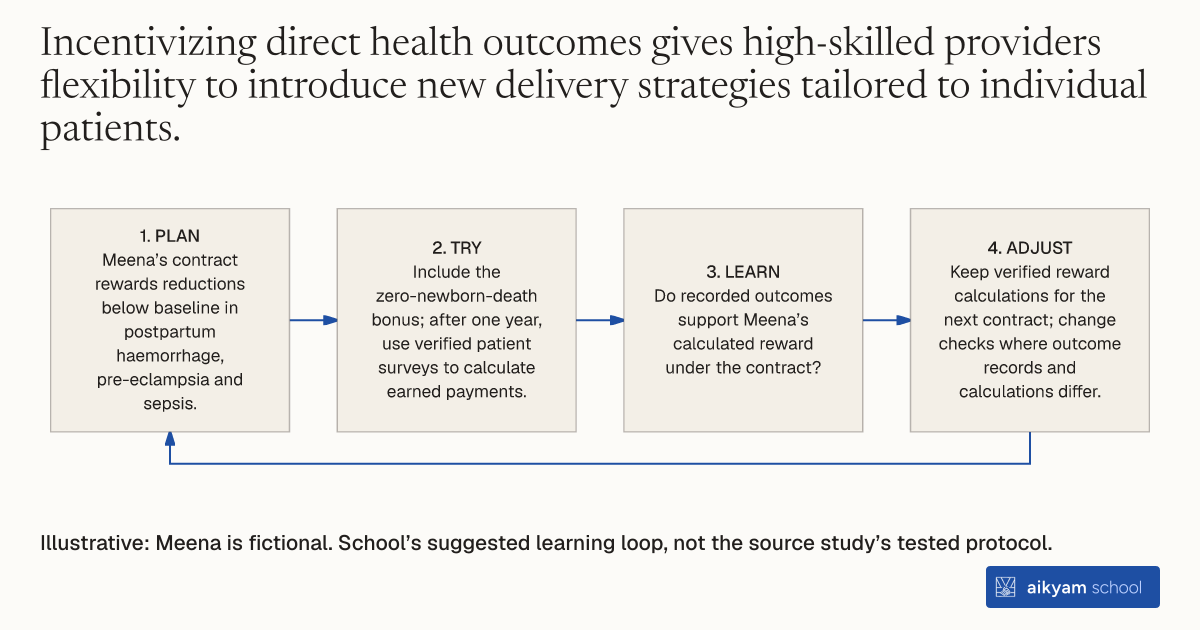
- Plan: Meena’s contract rewards reductions below baseline in postpartum haemorrhage, pre-eclampsia and sepsis.
- Try: Include the zero-newborn-death bonus; after one year, use verified patient surveys to calculate earned payments.
- Learn: Do recorded outcomes support Meena’s calculated reward under the contract?
- Adjust: Keep verified reward calculations for the next contract; change checks where outcome records and calculations differ.
Illustrative: Meena is fictional. School’s suggested learning loop, not the source study’s tested protocol.
See source →School’s suggested learning loop, not a tested source procedure. Observe baseline complications, survey outcomes and earned payments, capped at INR 150,000; this loop is not clinical protocol evidence.
How
When to use
Health systems in low-resource settings often seek to improve maternal health by focusing on actual health outcomes rather than prescribed medical tasks. Program designers need a contract mechanism that gives skilled clinicians flexibility to customize patient care. Output-based financial reward contracting pays healthcare providers directly for achieving measurable reductions in major maternal health complications.
Structure financial reward contracts that pay healthcare providers bonuses for reducing major causes of maternal mortality below pre-established baseline levels.
- Program managers set baseline incidence levels for post-partum hemorrhage, pre-eclampsia, and sepsis across participating clinics.
- Program leaders issue output contracts offering providers financial rewards up to INR 150,000 for reducing complications below baseline.
- Program managers include a bonus payment for clinicians who achieve zero newborn patient deaths.
- Clinicians adapt clinical care and apply new health delivery strategies to prevent target complications.
- Administrative staff evaluate verified patient survey data after one year to compute earned output bonuses and disburse payments.
Why it works
Rewarding complication reductions aligns clinician effort with critical health priorities within their direct clinical control.
Example
Researchers provided output-based reward contracts to 53 private obstetric care providers in rural Karnataka, India, offering potential bonus payments up to INR 150,000 for reducing postpartum hemorrhage, pre-eclampsia, and sepsis. Providers received an average payment of INR 56,812 and reduced postpartum hemorrhage rates by 7.4 percentage points.
About the study
Participants
53 private obstetric providers assigned to output contracts and 2,895 surveyed mothers across rural Karnataka, India.
Study Design
Randomized evaluation comparing 53 output contract providers against 38 input contract providers and 44 comparison group providers over a one-year contract period.
Results
Output reward contracts reduced patient postpartum hemorrhage probability by 7.4 percentage points (a 20 percent reduction) with an average payout of INR 56,812 (US\$1,033), though high-skilled providers achieved an 11 percentage point higher reduction than less qualified peers.