Try, learn and adjust
Check new cases before paying bonuses
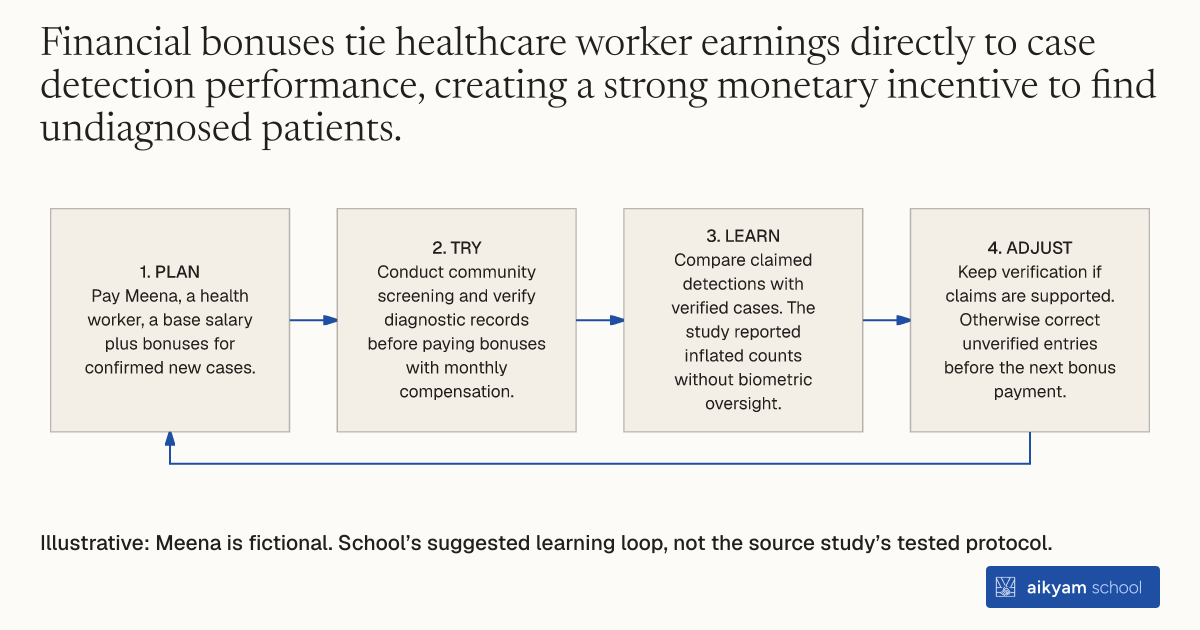
- Plan: Pay Meena, a health worker, a base salary plus bonuses for confirmed new cases.
- Try: Conduct community screening and verify diagnostic records before paying bonuses with monthly compensation.
- Learn: Compare claimed detections with verified cases. The study reported inflated counts without biometric oversight.
- Adjust: Keep verification if claims are supported. Otherwise correct unverified entries before the next bonus payment.
Illustrative: Meena is fictional. School’s suggested learning loop, not the source study’s tested protocol.
See source →School’s suggested, untested loop: observe diagnostic verification and bonus records; do not count unsupported cases as confirmed.
How
When to use
In primary healthcare programs, encouraging health workers to actively find and diagnose new patients is difficult on fixed salaries alone. Health workers often lack motivation to conduct time-consuming community outreach to locate undiagnosed individuals. Offering financial bonuses for every new case identified encourages providers to expand active screening efforts.
Provide financial bonuses to health workers for each newly identified and verified disease case.
- Pay health workers a base monthly salary to cover routine healthcare duties.
- Establish a supplementary bonus payment awarded for each confirmed new patient identified in the community.
- Task health workers with conducting community outreach and screening symptomatic individuals.
- Verify diagnostic records to confirm genuine new case detections before issuing bonus payments.
- Disburse bonus payments alongside monthly baseline compensation.
Example
Operation ASHA paid health workers a base monthly salary of Rs 5,600 (US\$90) plus case detection bonuses, but without biometric oversight, providers inflated new case counts by 20 percent to collect higher bonuses.
About the study
Participants
65 catchment areas serving urban informal settlements across four states in Northern India, each serving nearly 40,000 individuals and managed by one health worker.
Study Design
Randomized controlled trial across 65 catchment areas (34 treatment and 31 control), evaluating health worker compensation, case detection accuracy, and administrative records over 12 to 14 months.
Results
Health workers earned a base salary of Rs 5,600 (US\$90) per month plus case detection bonuses; introducing biometric tracking eliminated unverified entries, reducing new case overreporting by 20 percent and lowering bonus earnings by 7 percent (Rs 429 or US\$7).