Research records
Compare exit-rate slopes around day 90
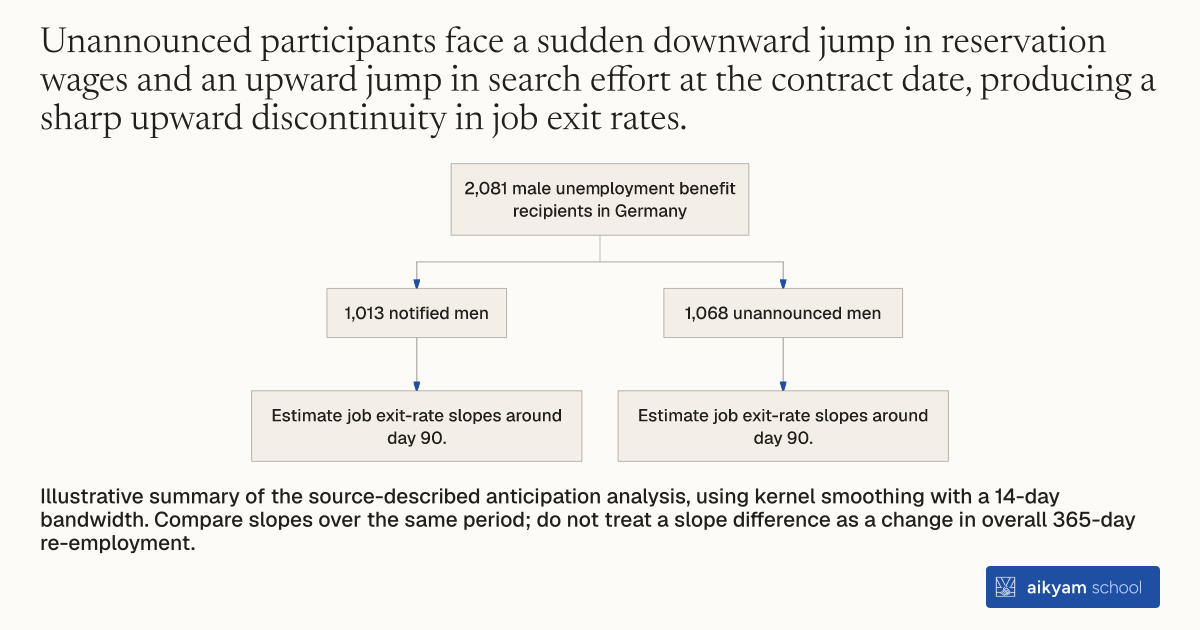
2,081 male unemployment benefit recipients in Germany
- 1,013 notified men
- Estimate job exit-rate slopes around day 90.
- 1,068 unannounced men
- Estimate job exit-rate slopes around day 90.
Illustrative summary of the source-described anticipation analysis, using kernel smoothing with a 14-day bandwidth. Compare slopes over the same period; do not treat a slope difference as a change in overall 365-day re-employment.
See source →How
When to use
Evaluating advance announcements of future interventions suffers from dynamic selection biases because randomization is lost when conditioning on survival until the meeting date. Comparing exit rates between notified and non-notified groups without assuming stationary search behavior can mask anticipatory adjustments. Nonstationary hazard slope discontinuity testing detects theoretical anticipation effects by measuring differences in the steepness of exit rate slopes around contract execution dates.
Estimate and compare empirical hazard rate slopes around an announced intervention threshold across notified and unannounced treatment arms to identify anticipatory job search behavior.
- Assign one treatment group to receive an advance notice of a future contract and another group to receive the contract without advance notice.
- Track daily job exit rates for both treatment groups from unemployment entry through the contractual threshold date.
- Formulate a nonstationary job search model with time-varying reservation wages and search effort functions up to the target contract date.
- Estimate kernel-smoothed hazard rates using a 14-day bandwidth across elapsed unemployment durations for both treatment arms.
- Compare the steepness of the empirical hazard slopes immediately preceding and following the contract date to test for an upward jump in exit rates among unannounced participants.
Why it works
In contrast, notified participants adjust their search strategy gradually in advance, resulting in a smoother, less steep hazard rate slope around the contract date.
Example
In five regional labor agencies in Germany, researchers estimated kernel hazard rates for 1,013 notified men and 1,068 non-notified men around day 90. Unannounced job seekers displayed a steeper increase in their job exit rate around day 90 than notified job seekers, confirming anticipatory behavior without altering overall 365-day re-employment probabilities.
About the study
Participants
2,081 male UI benefit recipients aged 25 to 64 in Germany assigned to treatment arms B (1,013) and C (1,068).
Study Design
Nonstationary search theoretical framework paired with kernel hazard rate slope estimation using a 14-day bandwidth around a 90-day contract threshold.
Results
Non-notified job seekers experienced a sharper upward jump in the empirical hazard rate around day 90 compared to advance-notified job seekers, confirming theoretical anticipation predictions while 365-day re-employment probabilities remained similar at 68.3% for group B and 69.7% for group C.