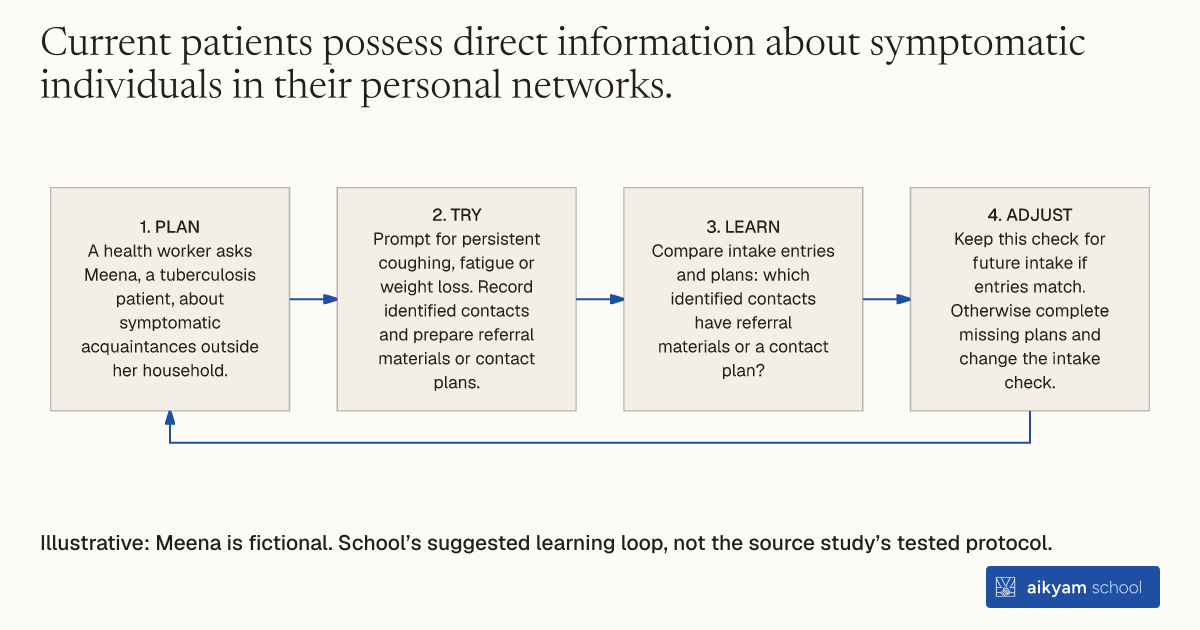
Try, learn and adjust
Check network contacts reach referral planning
- Plan: A health worker asks Meena, a tuberculosis patient, about symptomatic acquaintances outside her household.
- Try: Prompt for persistent coughing, fatigue or weight loss. Record identified contacts and prepare referral materials or contact plans.
- Learn: Compare intake entries and plans: which identified contacts have referral materials or a contact plan?
- Adjust: Keep this check for future intake if entries match. Otherwise complete missing plans and change the intake check.
Illustrative: Meena is fictional. School’s suggested learning loop, not the source study’s tested protocol.
See source →School's suggested, untested loop: observe identified contacts and referral preparation. This is not a tested clinical protocol.
How
When to use
Screening large populations to find tuberculosis cases requires testing many people and incurs high costs. Current tuberculosis patients often know people in their social networks outside their households who show disease symptoms. Healthcare providers use patient social networks to identify hidden tuberculosis cases in urban populations.
Ask current tuberculosis patients to identify symptomatic individuals in their social networks outside their households for screening.
- Community health workers contact current tuberculosis patients at health centers during or after treatment.
- Health workers encourage patients to think of acquaintances outside their households who exhibit symptoms such as persistent coughing, fatigue, or weight loss.
- Health workers record the identified symptomatic network members in project intake registers.
- Project staff prepare referral materials or contact plans for the identified individuals based on the patient's social network information.
Why it works
Shared risk factors and frequent social interactions make patient networks more likely to contain undetected disease cases.
Example
In India, researchers and Operation ASHA engaged 3,176 urban tuberculosis patients across 122 health centers to identify potential cases in their networks, leading to 216 individuals screened and 35 active cases confirmed.
About the study
Participants
3,176 urban tuberculosis patients undergoing or recently finishing treatment across 122 Operation ASHA centers in 10 Indian cities.
Study Design
Randomized evaluation comparing patient social network identification against standard health-worker contact tracing across 9 intervention groups.
Results
Peer referrals screened 216 individuals, with 170 individuals (78.7 percent) showing tuberculosis symptoms and 35 testing positive for active tuberculosis.