Try, learn and adjust
Check peer outreach is recorded at the clinic
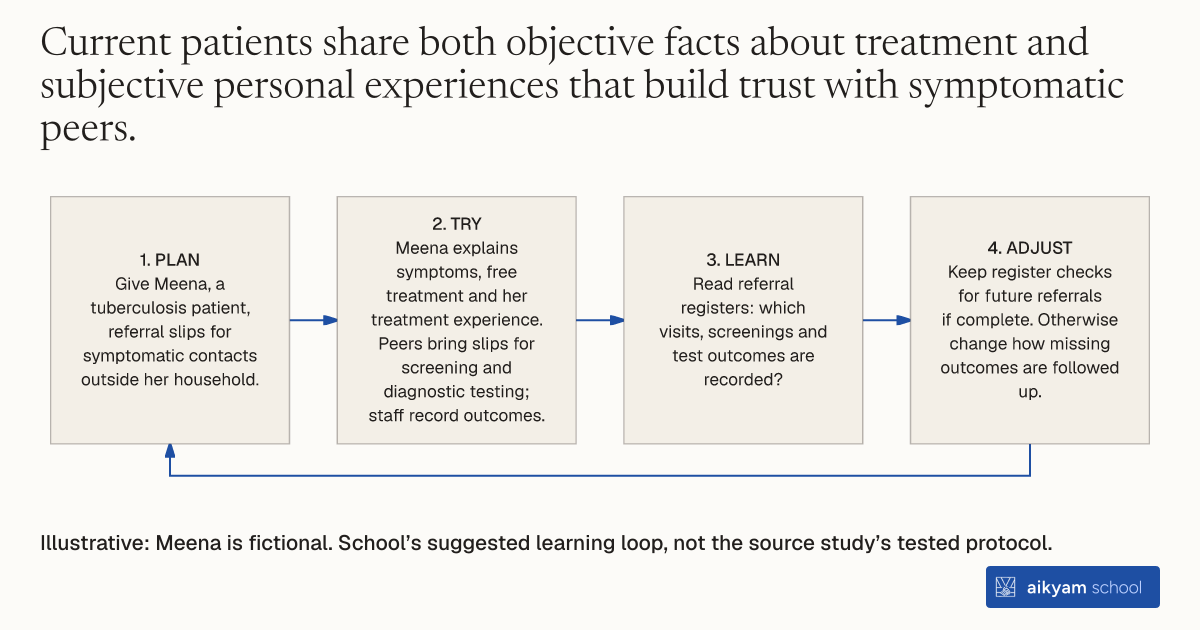
- Plan: Give Meena, a tuberculosis patient, referral slips for symptomatic contacts outside her household.
- Try: Meena explains symptoms, free treatment and her treatment experience. Peers bring slips for screening and diagnostic testing; staff record outcomes.
- Learn: Read referral registers: which visits, screenings and test outcomes are recorded?
- Adjust: Keep register checks for future referrals if complete. Otherwise change how missing outcomes are followed up.
Illustrative: Meena is fictional. School’s suggested learning loop, not the source study’s tested protocol.
See source →School's suggested, untested loop: observe referral details and recorded outcomes. This is not a tested clinical protocol.
How
When to use
Screening large urban populations for tuberculosis yields low detection rates and high operational costs. Health workers struggle to reach symptomatic individuals who hide due to social stigma or lack of information. Current tuberculosis patients directly engage symptomatic peers in their social networks to inform them and connect them to health clinics.
Distribute referral cards to current patients so they can inform symptomatic acquaintances and encourage them to seek testing at health clinics.
- Health workers give physical referral cards to current tuberculosis patients at community treatment clinics.
- Patients identify symptomatic acquaintances in their social networks outside their households.
- Patients explain tuberculosis symptoms, local clinic locations, free treatment options, and personal treatment experiences to identified peers.
- Patients hand referral cards to these individuals and urge them to visit a local clinic.
- Referred individuals present their referral cards to health workers at clinics for screening and diagnostic testing.
- Clinic staff record the referral card details and screening outcomes in official referral registers.
Why it works
Direct peer communication overcomes social stigma and costs less than health-worker contact tracing.
Example
In India, researchers tested peer outreach across 122 Operation ASHA centers, finding that incentivized peer outreach resulted in one new individual screened for every 5.6 current patients and proved 2.5 to 3.5 times less expensive than health-worker outreach.
About the study
Participants
3,176 urban tuberculosis patients across 122 Operation ASHA centers in 10 Indian cities.
Study Design
Randomized evaluation comparing peer-led outreach against status-quo health-worker contact tracing across varying reward structures.
Results
Peer outreach led to higher identification of active tuberculosis cases than health-worker contact tracing and was 2.5 to 3.5 times less expensive.