Research procedure
Measure peanut-bagging output
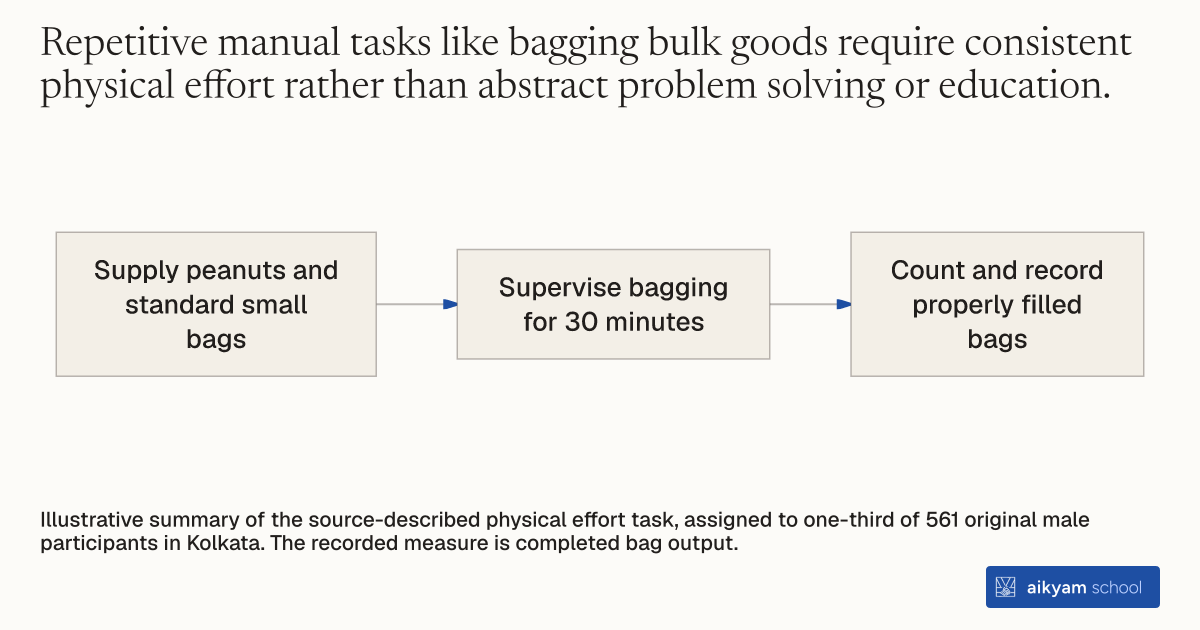
- Supply peanuts and standard small bags
- Supervise bagging for 30 minutes
- Count and record properly filled bags
Illustrative summary of the source-described physical effort task, assigned to one-third of 561 original male participants in Kolkata. The recorded measure is completed bag output.
See source →How
When to use
Evaluate manual physical effort and diligence among casual labor market participants using a standardized manual task. This isolates physical stamina and repetitive effort from cognitive problem-solving ability. Use this method when measuring non-cognitive manual task productivity in informal or low-skill labor settings.
Administer a 30-minute timed peanut-bagging task to evaluate worker manual effort and repetitive physical output under supervisor monitoring.
- Provide each participant with bulk unbagged peanuts and standardized small plastic bags at a supervised work station.
- Instruct participants to fill as many small bags of peanuts as possible within a continuous 30-minute time window.
- Supervise the work session directly to ensure consistent compliance and quality control across participants.
- Count the total number of properly filled peanut bags completed by each participant upon session conclusion.
- Record total completed bag output as a standardized measure of physical effort productivity.
Why it works
Measuring output over a fixed time window creates an objective baseline metric of manual physical productivity.
Example
Field staff assigned a subset of original workers in Kolkata, India, to complete a 30-minute peanut-bagging task under low-stakes payment contracts. The task produced objective physical output counts but showed no significant referral performance differences under low-stakes incentive levels.
About the study
Participants
One-third of the 561 original male participants in Kolkata, India.
Study Design
Randomized assignment to a 30-minute manual peanut-bagging physical effort task evaluated under low-stakes fixed and performance pay contracts.
Results
Evaluated physical effort productivity under low-stakes contracts without finding mean referral performance differences, driven by smaller sample size and the absence of high-stakes incentive tiers.