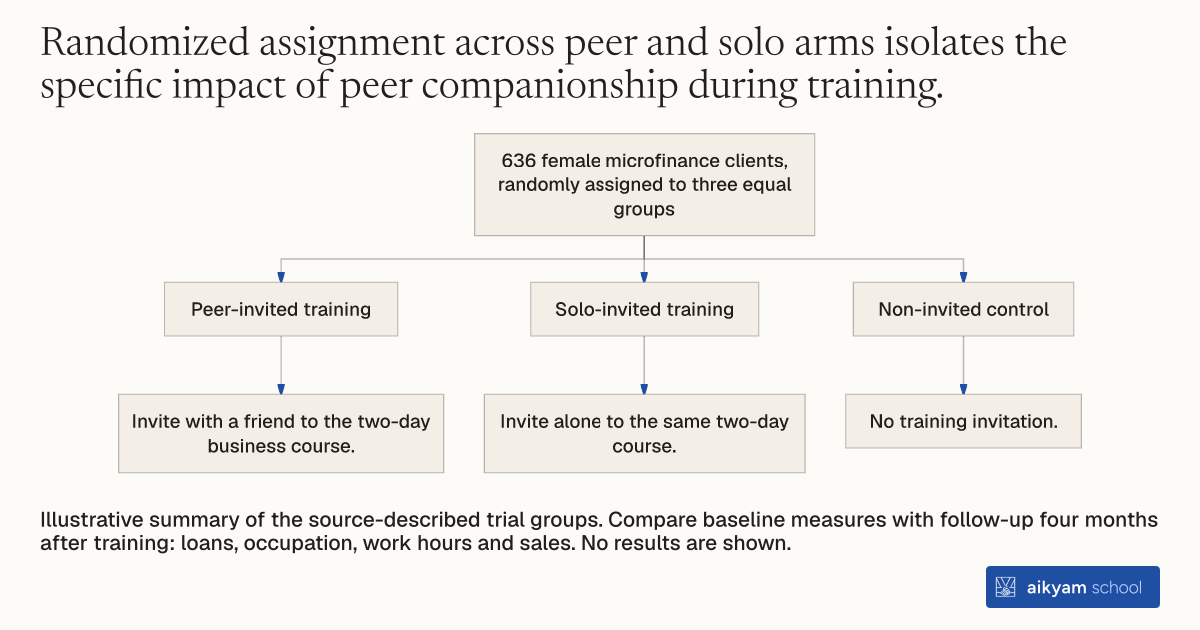
Research allocation
Compare peer and solo training invitations
636 female microfinance clients, randomly assigned to three equal groups
- Peer-invited training
- Invite with a friend to the two-day business course.
- Solo-invited training
- Invite alone to the same two-day course.
- Non-invited control
- No training invitation.
Illustrative summary of the source-described trial groups. Compare baseline measures with follow-up four months after training: loans, occupation, work hours and sales. No results are shown.
See source →How
When to use
Evaluating micro-enterprise programs for women requires randomized testing to isolate the effect of peer support from general education. Traditional evaluations often fail to separate individual skill gain from peer encouragement. Conduct a randomized controlled trial comparing peer-invited, solo-invited, and non-invited groups to measure peer impact on female entrepreneurship.
Measure the impact of peer support in business training using a randomized controlled evaluation across three experimental arms.
- Form a study sample of female microfinance clients in urban informal markets.
- Randomly assign clients to three equal groups: peer-invited training, solo-invited training, or a non-invited control group.
- Deliver a standard two-day business and financial curriculum to invited clients in their assigned groups.
- Collect baseline survey data on participant demographics, baseline business activity, and social norm restrictions.
- Conduct a follow-up survey four months after training to measure business loan uptake, occupational status, labor hours, and sales volume.
Why it works
Comparing these groups against an uninvited control group allows researchers to measure true changes in loan demand and business growth.
Example
Researchers evaluated a business training program for 636 female SEWA Bank clients in Ahmedabad, India, across three randomized groups. Four months after training, women invited with a peer were 7 percentage points more likely to take a loan and 4 percentage points less likely to report working as a housewife, whereas women invited alone showed no significant loan or sales increase compared to the control group.
About the study
Participants
636 female microfinance clients aged 18 to 50 in Ahmedabad, India.
Study Design
Three-arm randomized controlled trial comparing peer-invited training, solo-invited training, and a control group over four months.
Results
Women invited with a friend were 7 percentage points (117 percent) more likely to take a business loan and 4 percentage points (40 percent) less likely to report their primary occupation as housewife, while solo-invited women showed no statistically significant differences in loans or sales compared to control.