Research procedure
Calculate the test-score raise tournament
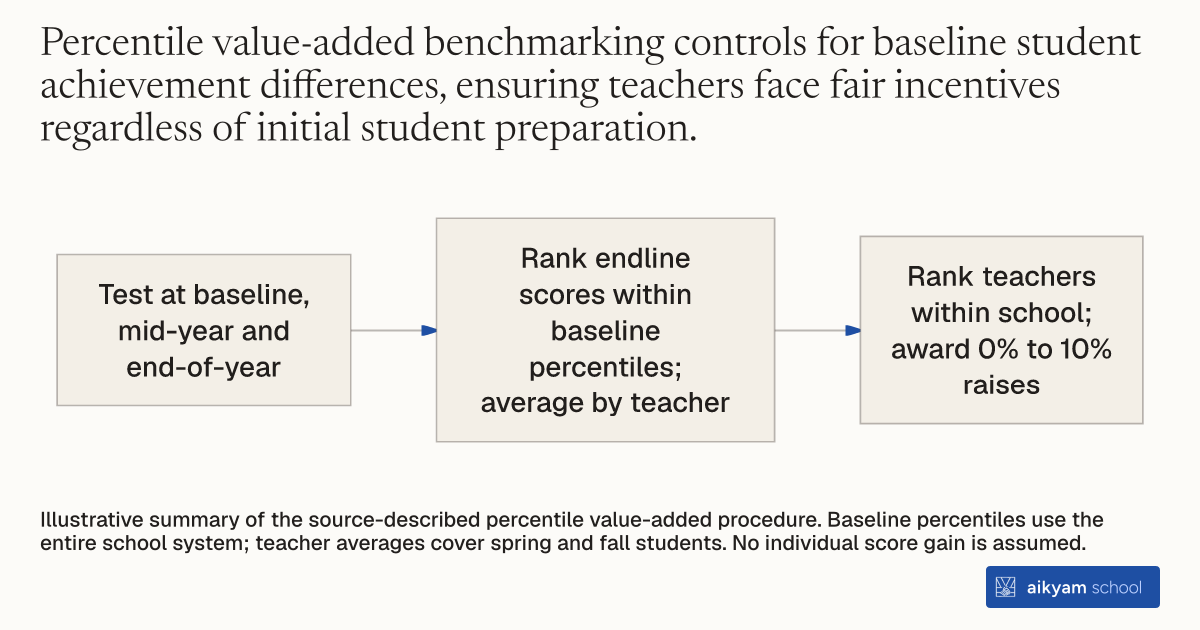
- Test at baseline, mid-year and end-of-year
- Rank endline scores within baseline percentiles; average by teacher
- Rank teachers within school; award 0% to 10% raises
Illustrative summary of the source-described percentile value-added procedure. Baseline percentiles use the entire school system; teacher averages cover spring and fall students. No individual score gain is assumed.
See source →How
When to use
Organizations seek to motivate employee productivity using quantitative output measures while holding overall bonus budget variance fixed. Objective output contracts address non-verifiable effort by directly tying financial raises to benchmarked performance metrics. This method suits school systems aiming to increase academic student test scores through transparent, rank-ordered outcome rewards.
Reward teachers with annual salary raises based on student percentile value-added test scores calculated through a within-school tournament.
- Administer baseline standardized exams to all enrolled students across core subjects at the beginning of the school year.
- Group students across the entire school system into baseline test score percentiles to establish baseline achievement tiers.
- Test students at mid-year and end-of-year on standardized exams designed and administered by central education authority teams.
- Calculate each student's endline test percentile relative to all system-wide students who shared the exact same baseline percentile.
- Average the percentile value-added scores across all students taught by each teacher during the spring and fall terms.
- Rank teachers within each school into percentile tiers and assign annual salary raises from 0% to 10% based on their tournament rank.
Why it works
Ranking performance within schools holds overall raise budget expenditures constant while providing clear outcome-based motivation.
Example
A private school system in Pakistan assigned core teachers across 234 schools to a percentile value-added tournament contract. Teachers earning top percentile ranks received up to a 10% salary raise, which increased student test scores by 0.092 standard deviations while causing a 5-fold increase in classroom test preparation time.
About the study
Participants
6,080 teachers (80% female), 189 managers, and 141,566 student-subject test observations across 234 private schools in Pakistan (grades 4–13).
Study Design
Randomized controlled trial (RCT) comparing flat 5% raises, manager-discretionary subjective performance raises (0–10%), and percentile value-added objective raises (0–10%) in within-school tournaments over an 18-month review cycle.
Results
Objective incentives increased student test scores by 0.0918 standard deviations (p = 0.0730), increased test prep time from 0.14 to 0.76 minutes per 20-minute segment (p = 0.00455), decreased CLASS pedagogy scores by 0.0713 points (p = 0.123), and reduced student love of learning by 0.0882 standard deviations (p = 0.116).