Research procedure
Survey voters after the election
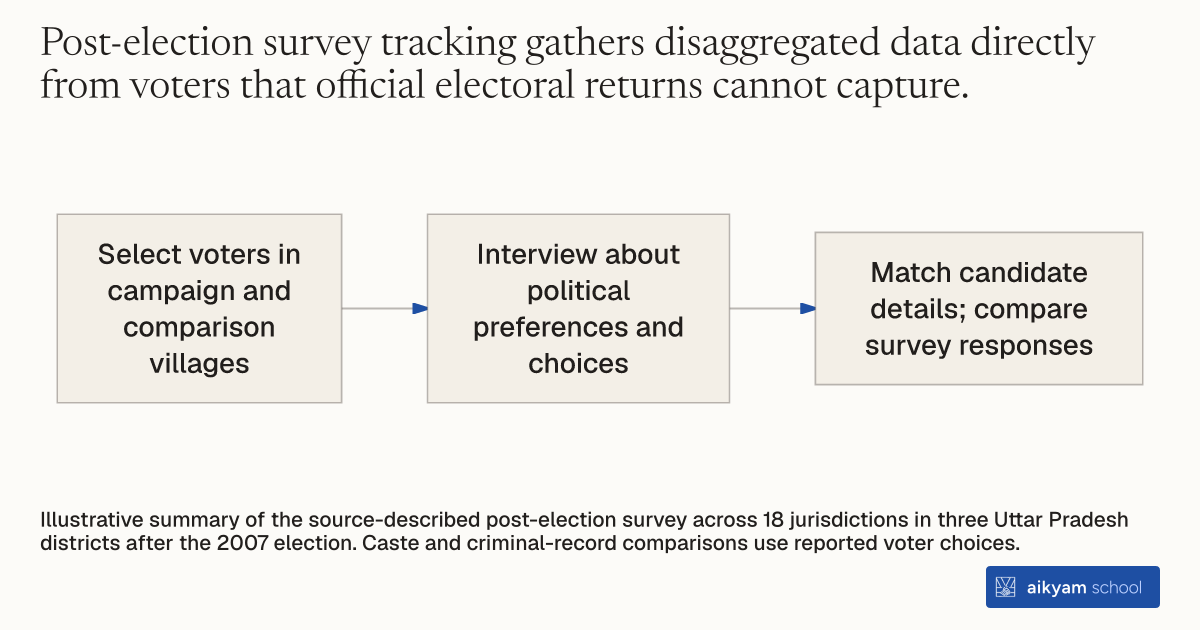
- Select voters in campaign and comparison villages
- Interview about political preferences and choices
- Match candidate details; compare survey responses
Illustrative summary of the source-described post-election survey across 18 jurisdictions in three Uttar Pradesh districts after the 2007 election. Caste and criminal-record comparisons use reported voter choices.
See source →How
When to use
Researchers and evaluation teams need to measure individual voter choices after campaign interventions. Official ballot box records show aggregate turnout but cannot track individual identity-based voting or candidate preference shifts. Administer post-election surveys to gather data on voter decisions and party preferences across campaign treatment areas.
Collect post-election voter survey data to evaluate changes in individual voting behavior across campaign jurisdictions.
- Partner with an independent survey organization, such as the Center for the Study of Developing Societies, to design survey instruments.
- Select representative samples of voters in target and comparison villages following an election.
- Conduct in-person interviews with voters to record their individual political preferences and party choices.
- Match respondent choices with candidate caste backgrounds and criminal records.
- Compare responses between treatment and comparison areas to measure shifts in identity-based voting.
Why it works
This detail enables researchers to isolate shifts in caste-based candidate preferences and voter turnout.
Example
Researchers collaborated with the Center for the Study of Developing Societies to collect survey data following the 2007 Uttar Pradesh elections across 18 jurisdictions in 3 districts. The survey showed that the anti-caste campaign decreased the likelihood of an individual voting for a candidate from their own caste by 10 percent.
About the study
Participants
18 jurisdictions in 3 districts in rural Uttar Pradesh, India, targeting rural voters.
Study Design
Post-election survey data collected by the Center for the Study of Developing Societies to evaluate randomized campaign interventions during the 2007 elections.
Results
Survey tracking revealed a 10 percent decrease in the likelihood that an individual voted for their caste-preferred candidate and identified a 50 percent reduction in vote share for politicians facing heinous criminal charges.