Research survey
Ask candidates about community nomination
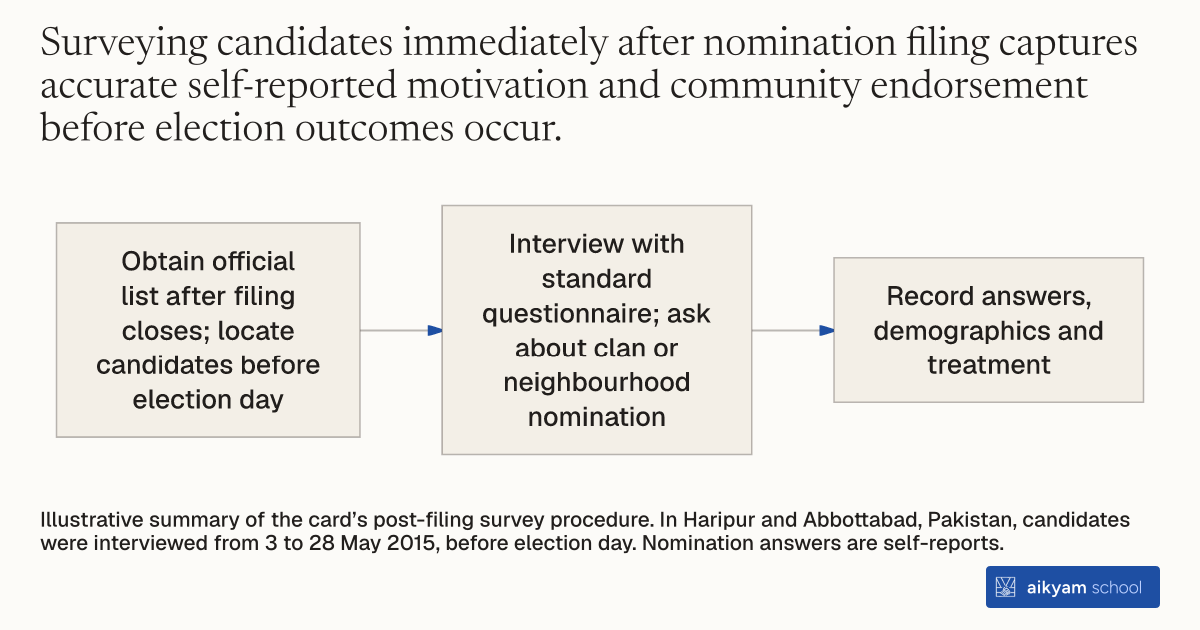
- Obtain official list after filing closes; locate candidates before election day
- Interview with standard questionnaire; ask about clan or neighbourhood nomination
- Record answers, demographics and treatment
Illustrative summary of the card’s post-filing survey procedure. In Haripur and Abbottabad, Pakistan, candidates were interviewed from 3 to 28 May 2015, before election day. Nomination answers are self-reports.
See source →How
When to use
Understanding whether political candidates enter races independently or through community mobilization requires gathering self-reported nomination data shortly after candidate filing closes. Relying solely on official ballot lists misses the social mechanisms behind candidate entry. Surveying confirmed candidates post-filing tracks whether local clans or neighborhood groups actively nominated them.
Administer a structured survey to all confirmed election candidates in the weeks following official nomination filing.
- Obtain the official candidate list from local district offices of the Election Commission once candidate filing closes.
- Locate each candidate in their respective village between the close of nominations and election day.
- Conduct an in-person interview with each candidate using a standardized questionnaire.
- Ask candidates whether their local clan or neighborhood formally or informally nominated them to run for council office.
- Record responses alongside candidate demographic details and assigned experimental treatment conditions.
Why it works
This identifies whether recruitment interventions stimulate individual self-selection or informal community coordination.
Example
In Haripur and Abbottabad districts of Pakistan, enumerators interviewed candidates between May 3 and May 28, 2015, after nomination papers were filed. In social versus personal villages, candidates were 1.8 percentage points more likely to report being nominated by their clan or neighborhood to run for village council.
About the study
Participants
9,310 male citizens (and 290 verified candidates) across 192 villages in Haripur and Abbottabad districts, Khyber Pakhtunkhwa province, Pakistan.
Study Design
A post-filing candidate survey administered between May 3 and May 28, 2015, following candidate paper submission and prior to election day, measuring self-reported community nomination.
Results
Delivering social versus personal messages increased the likelihood that candidates reported being nominated by their clan or neighborhood by 1.8 percentage points (p = 0.007).