Research survey
Ask candidates about their campaigns
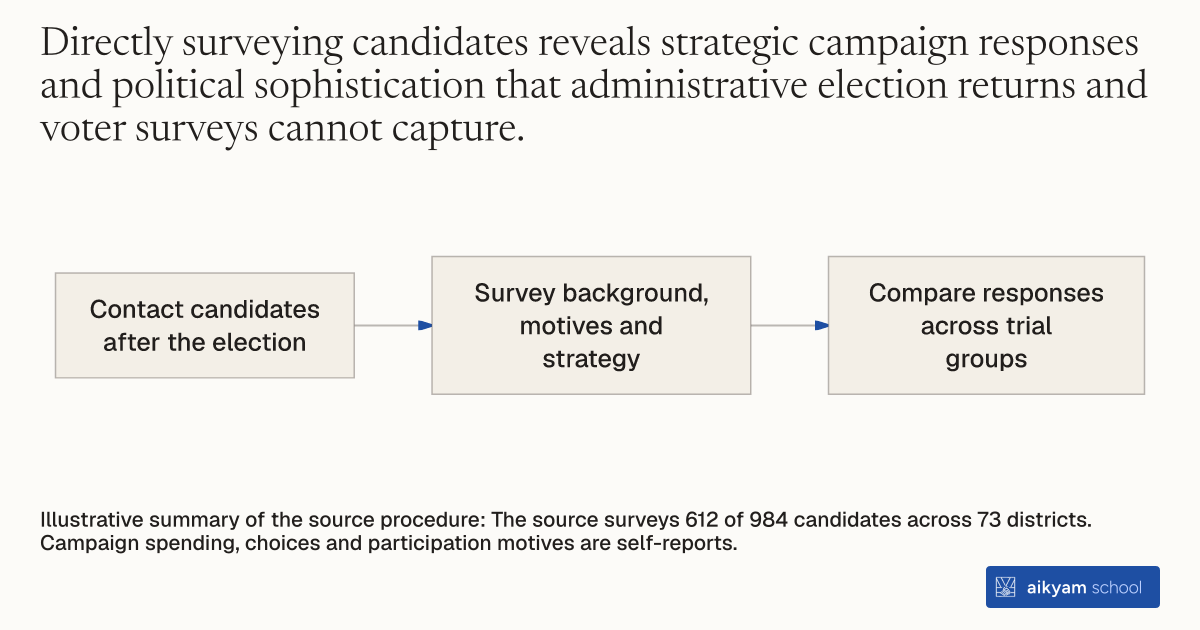
- Contact candidates after the election
- Survey background, motives and strategy
- Compare responses across trial groups
Illustrative summary of the source procedure: The source surveys 612 of 984 candidates across 73 districts. Campaign spending, choices and participation motives are self-reports.
See source →How
When to use
In political economy evaluation, researchers need to evaluate candidate campaign decisions, media habits, and motives for debate attendance without relying solely on citizen recall. Standard voter surveys miss the internal calculations of politicians. This approach gathers primary data directly from election candidates following an electoral contest.
Administer a post-election candidate survey to evaluate strategic campaign adjustments, debate participation motives, and candidate background characteristics.
- Deploy enumerators to contact all candidates who contested seats in the targeted election across all participating districts.
- Record demographic background details, university education, prior government or NGO employment, prior candidacy, and self-reported campaign expenditures.
- Survey candidates regarding their underlying reasons for participating in or abstaining from public candidate debates.
- Measure candidate campaign choices, tracking changes in radio appearances, on-the-ground community visits, and gift distribution.
- Quantify candidate attitudes toward promise credibility across radio broadcasts versus live campaign rallies.
Why it works
This allows researchers to verify mechanisms like campaign crowd-out and media interview demand.
Example
Researchers surveyed 612 legislative candidates who contested the 2017 election across 73 districts in Liberia. The survey revealed that 68 percent of incumbents changed their campaign strategy due to debates, with 60 percent emphasizing radio appearances, while 73 percent of challengers adjusted on-the-ground campaigning.
About the study
Participants
612 legislative candidates surveyed out of 984 candidates across all 73 electoral districts in Liberia following the October 2017 election.
Study Design
Post-election candidate survey administered across treatment and control districts to measure candidate background, debate attendance motives, and campaign strategy adjustments.
Results
Achieved a balanced response rate across treatment arms; 68 percent of incumbents reported changing campaign strategy compared to 52 percent of challengers; 60 percent of strategic incumbents shifted toward radio appearances compared to 27 percent of challengers; incumbents reported spending \$61,458 on campaigns versus \$41,282 for challengers.