Research procedure
Survey after the growing season
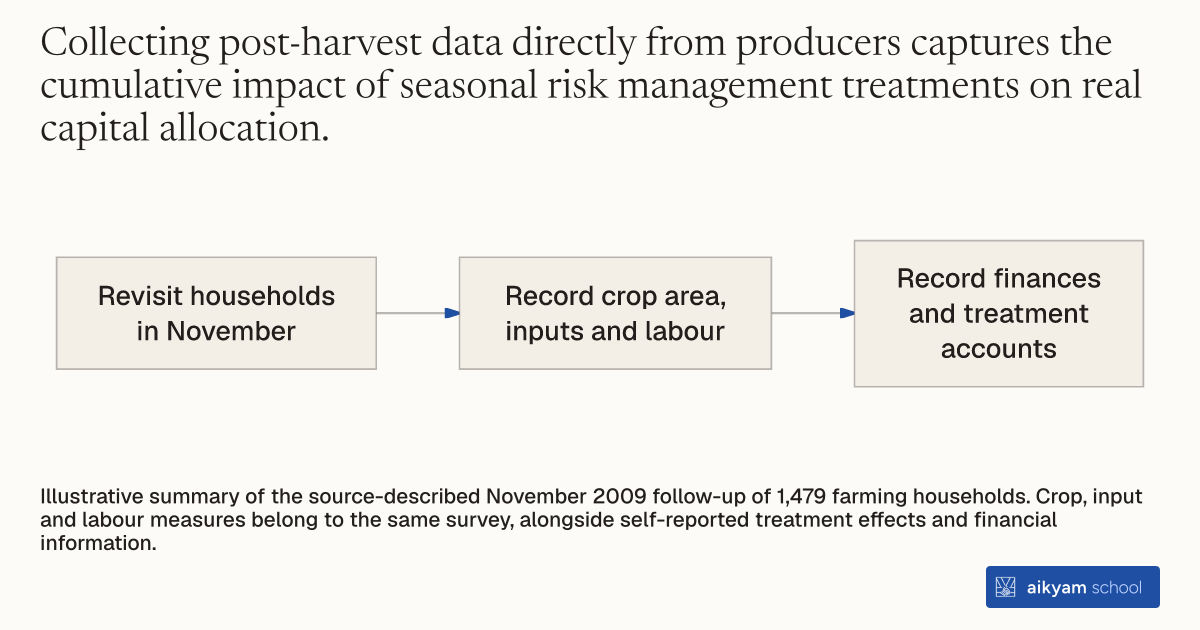
- Revisit households in November
- Record crop area, inputs and labour
- Record finances and treatment accounts
Illustrative summary of the source-described November 2009 follow-up of 1,479 farming households. Crop, input and labour measures belong to the same survey, alongside self-reported treatment effects and financial information.
See source →How
When to use
An agricultural intervention needs to evaluate whether a seasonal risk-mitigation product altered farm investments and crop allocation. Measuring outcomes only at baseline or during mid-season fails to capture final harvest decisions, input market value used, and land sowed. Field enumerators re-survey participants post-harvest to collect comprehensive end-of-season production data across all crops.
Revisit participating farming households immediately following the agricultural harvest season to quantify input expenditures, land cultivation, and crop selection across all grown crops.
- Deploy trained survey enumerators to visit study households in November at the conclusion of the monsoon growing season.
- Record total cultivated acreage disaggregated by specific crop types, including rain-fed cash crops and subsistence crops.
- Quantify physical quantities and estimated market values of agricultural inputs used, including seeds, chemical fertilizers, organic manure, pesticides, and irrigation.
- Record labor usage and expenditures, disaggregating manual labor, bullock labor, tractor rentals, and other equipment implement costs.
- Collect qualitative self-reported data regarding how experimental risk treatments influenced input purchases, planting dates, and decisions to abandon or replant crops.
- Record household financial asset balances, outstanding credit obligations, livestock holdings, and weather expectations following the harvest.
Why it works
Standardized recall surveys across both general inputs and crop-specific expenditures allow researchers to separate extensive margin crop-switching effects from intensive margin input adjustments.
Example
ICRISAT enumerators revisited 1,479 farming households across 45 villages in Mahbubnagar and Anantapur, Andhra Pradesh, India, in November 2009. The post-monsoon survey revealed that 93% of farmers cultivated crops during the 2009 monsoon, spending an average total market value of Rs. 22,377 on inputs across all crops and Rs. 6,123 specifically on cash crops (castor and groundnut).
About the study
Participants
1,479 smallholder farming households across 45 villages in Mahbubnagar and Anantapur, Andhra Pradesh, India; 54% unschooled, average landholding 5.37 acres.
Study Design
Randomized Controlled Trial using Tobit and Probit regression estimators with village fixed effects on post-monsoon survey data comparing insurance recipients against cash-compensated control farmers.
Results
Post-monsoon data showed that insurance increased the likelihood of planting cash crops by 6 percentage points (p = 0.041), cash crop land planted by 0.163 log acres (p = 0.021), and cash crop input expenditure by 0.800 log points (p = 0.039).