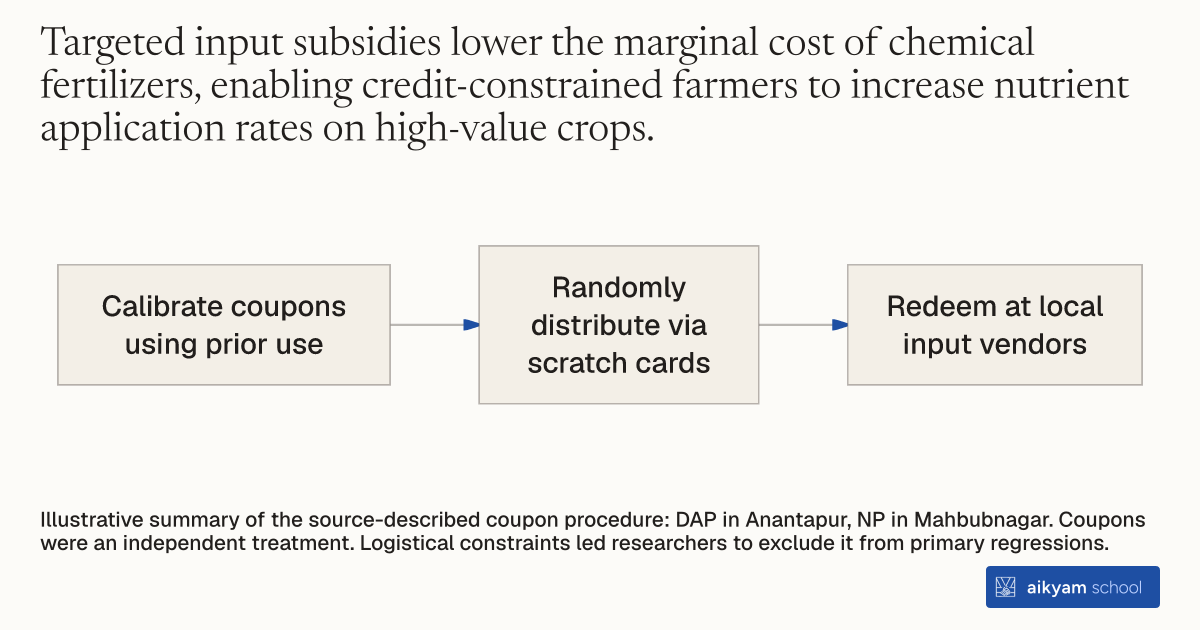
Research procedure
Allocate local fertiliser discounts
- Calibrate coupons using prior use
- Randomly distribute via scratch cards
- Redeem at local input vendors
Illustrative summary of the source-described coupon procedure: DAP in Anantapur, NP in Mahbubnagar. Coupons were an independent treatment. Logistical constraints led researchers to exclude it from primary regressions.
See source →How
When to use
An agricultural development program seeks to boost crop yields by reducing the upfront purchase price of inorganic fertilizers for smallholder farmers. Financial liquidity constraints often prevent low-income agricultural producers from buying optimal quantities of chemical inputs at market rates. Program administrators distribute targeted discount coupons for locally appropriate fertilizer blends at the start of the planting season to lower input costs.
Distribute randomized discount coupons for region-specific inorganic fertilizers to agricultural households alongside baseline pre-monsoon survey visits.
- Identify the primary inorganic fertilizer blends used for rain-fed cash crops in each regional district, such as DAP or NP fertilizer.
- Calibrate coupon subsidy quantities and discount levels based on historical regional fertilizer consumption data.
- Print discount coupons corresponding to local fertilizer types and pack them into randomized treatment assignment materials.
- Distribute discount coupons to selected farming households via scratch cards during pre-monsoon household visits in June.
- Instruct coupon recipients to redeem the vouchers at local agricultural input vendors when purchasing fertilizer bags for the upcoming growing season.
Why it works
Direct price discounts reduce upfront liquidity requirements during the early planting window when farm cash reserves are lowest.
Example
Field enumerators distributed discount coupons for locally appropriate inorganic fertilizer (DAP in Anantapur and NP fertilizer in Mahbubnagar) to smallholder farmers across 45 villages in Andhra Pradesh, India, in June 2009. The subsidy quantity was calibrated based on a 2006 baseline survey where 70% of farmers in Mahbubnagar and 34.4% in Anantapur used fertilizer, purchasing at most two bags.
About the study
Participants
1,479 smallholder farming households across 45 villages in Mahbubnagar and Anantapur, Andhra Pradesh, India; 54% unschooled, average landholding 5.37 acres.
Study Design
Randomized Controlled Trial evaluating input subsidies delivered independently via scratch cards, calibrated to baseline survey consumption data.
Results
Implementation faced logistical constraints because actual fertilizer usage in 2009 was much higher than calibrated from 2006 data (95% of farmers used fertilizer in 2009, spending an average of Rs. 3,156), leading the researchers to exclude the coupon treatment from primary statistical regressions.