Research procedure
Measure beliefs before and after information
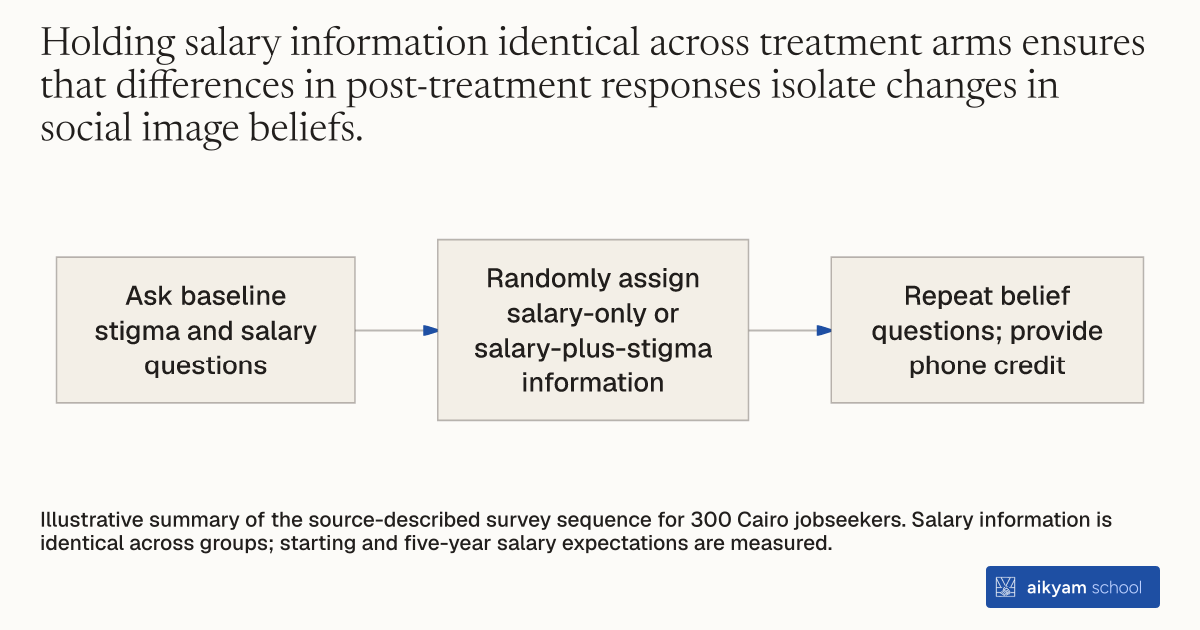
- Ask baseline stigma and salary questions
- Randomly assign salary-only or salary-plus-stigma information
- Repeat belief questions; provide phone credit
Illustrative summary of the source-described survey sequence for 300 Cairo jobseekers. Salary information is identical across groups; starting and five-year salary expectations are measured.
See source →How
When to use
Researchers and evaluators often struggle to determine whether messaging interventions alter psychological stigma beliefs or monetary return expectations. Program designers need a method to isolate mechanisms and verify that information treatments change social image perceptions without confounding income expectations. This approach serves job assistance organizations seeking to measure baseline and post-treatment beliefs among jobseekers.
Conduct an online survey experiment with pre- and post-information questions to track changes in stigma beliefs and income expectations among jobseekers.
- Partner with an employment organization to enroll jobseekers into an online survey platform.
- Collect baseline demographic characteristics including age, gender, education, and employment status.
- Ask baseline questions regarding perceptions of societal stigma and expected short-term and five-year salaries for entry-level positions.
- Randomly assign respondents to receive either salary-only information or salary information combined with a salient stigma statement.
- Re-ask the questions regarding societal stigma, family pride, peer respect, and expected starting and five-year salaries.
- Provide telephone credit to participants upon survey completion in appreciation for their time.
Why it works
Tracking baseline and endline beliefs enables ANCOVA estimation of direct treatment effects on non-monetary perceptions.
Example
Researchers partnered with the National Employment Pact in Cairo, Egypt to survey 300 blue-collar jobseekers using phone credit incentives. Receiving the salient stigma script increased the belief that society looks down on entry-level jobs by 0.10 points without altering short-term or five-year salary expectations.
About the study
Participants
300 unemployed and underemployed blue-collar jobseekers in Greater Cairo, Egypt.
Study Design
Online randomized survey experiment using ANCOVA regressions controlling for baseline values to evaluate post-treatment belief changes across control and treatment arms.
Results
The salient stigma statement significantly increased beliefs that society looks down on entry-level jobs (+0.10 points, p < 0.01) and reduced expected family pride (-0.15 points, p < 0.10), while producing no significant change in current salary expectations (+57 EGP/month, p = 0.27) or five-year salary expectations (-92 EGP/month, p = 0.46).