Research classification
Identify predicted leading candidates
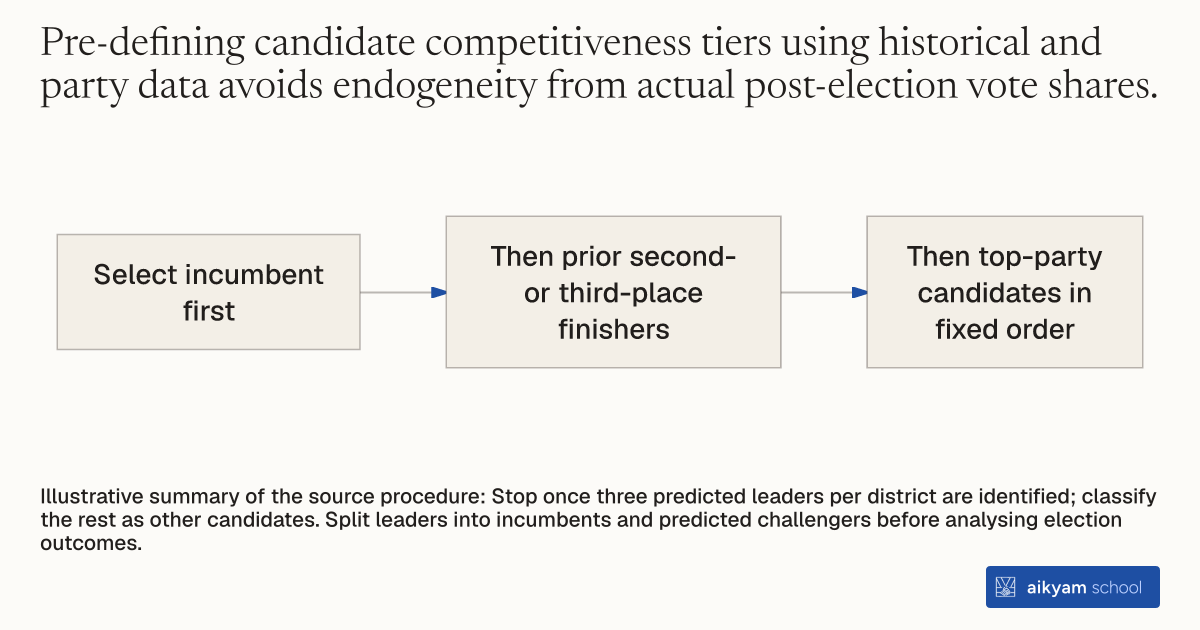
- Select incumbent first
- Then prior second- or third-place finishers
- Then top-party candidates in fixed order
Illustrative summary of the source procedure: Stop once three predicted leaders per district are identified; classify the rest as other candidates. Split leaders into incumbents and predicted challengers before analysing election outcomes.
See source →How
When to use
In electoral research with dozens of competing political candidates per constituency, evaluating voter responses to every candidate is practically impossible. Researchers need a systematic way to identify viable candidates without creating statistical bias from actual election results. This method classifies parliamentary candidates into distinct competitiveness tiers based on historical and party criteria.
Classify legislative candidates into competitiveness tiers by applying a sequential three-step prediction rule prior to analyzing electoral outcomes.
- Assign any candidate currently holding the electoral district seat as the district incumbent.
- Select non-incumbent candidates who ran in the previous legislative election and finished in second or third place.
- Select candidates belonging to major political parties in fixed sequential order until exactly three predicted leading candidates are identified per district.
- Categorize all remaining candidates in the district as other candidates.
- Divide the three predicted leading candidates into incumbents and predicted challengers for comparative analysis.
Why it works
Identifying the top viable candidates allows research teams to measure citizen learning and candidate strategy without overwhelming survey respondents.
Example
Researchers classified 984 legislative candidates across 73 Liberian districts in 2017 into 219 predicted leading candidates and 765 other candidates. The categorization successfully identified frontrunners, with predicted leading candidates finishing in the top three in 50 percent of districts and in the top five in 71 percent of districts.
About the study
Participants
984 legislative candidates across 73 electoral districts in Liberia during the October 2017 House of Representatives election.
Study Design
Sequential candidate classification rule validated against administrative polling station election returns across all 73 districts.
Results
Identified 219 predicted leading candidates (64 incumbents and 155 predicted challengers) and 765 other candidates; predicted leading candidates placed in the top three in 50 percent of cases and top five in 71 percent of cases.