Research procedure
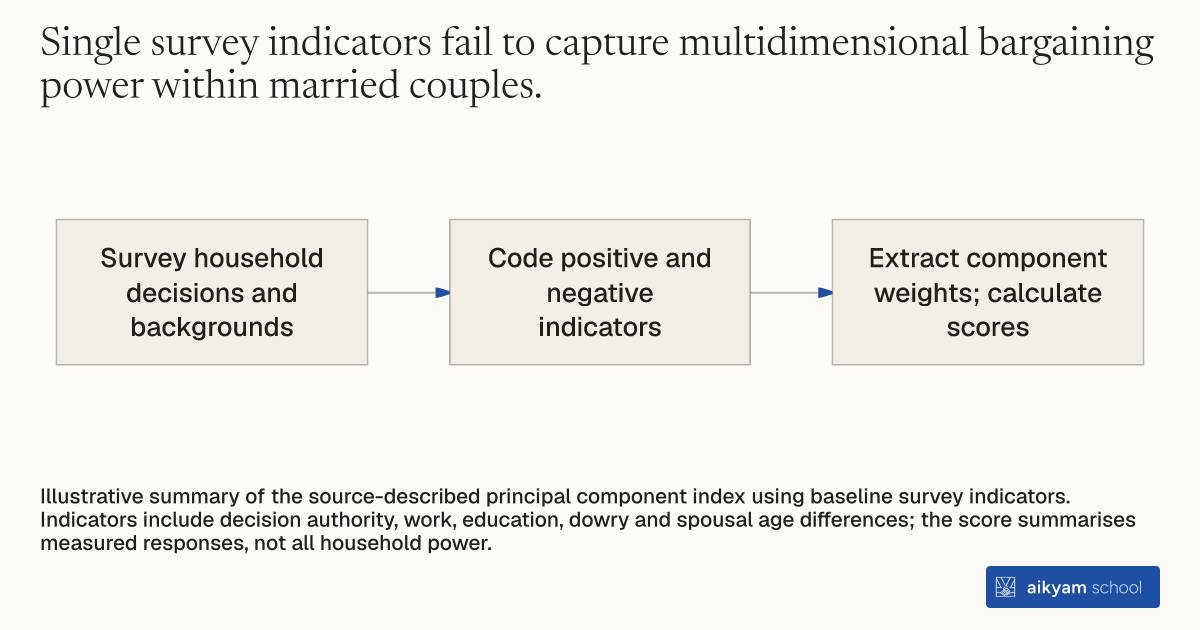
Combine measures of women’s decision power
- Survey household decisions and backgrounds
- Code positive and negative indicators
- Extract component weights; calculate scores
Illustrative summary of the source-described principal component index using baseline survey indicators. Indicators include decision authority, work, education, dowry and spousal age differences; the score summarises measured responses, not all household power.
See source →How
When to use
Development programs struggle to evaluate complex household power dynamics using single survey questions. Program teams need a statistical summary tool to quantify a woman's relative decision-making authority within her family. This method constructs a composite empowerment index using principal component analysis across multiple demographic and domestic variables.
Construct a unified index of female empowerment using principal component analysis on survey dummy variables.
- Administer a baseline survey measuring household decision authority, spousal age gaps, and education levels.
- Code positive dummy variables for female food choice autonomy, wage contributions, food purchase authority, and education.
- Code negative dummy variables for past work denial by husbands, child marriage before age 16, dowry payments, and male age or educational dominance.
- Run principal component analysis across the survey dummy variables to extract primary factor weights.
- Calculate composite empowerment scores for each household to analyze how bargaining power influences technology adoption choices.
Why it works
Principal component analysis reduces multiple correlated social indicators into one continuous statistical measure of decision-making authority.
Example
Researchers evaluated female empowerment across 400 rural households in Jamalpur and Hatia, Bangladesh. When cookstoves were offered at positive prices, a higher female empowerment score increased female chimney stove orders by 8 percentage points or 14%.
About the study
Participants
400 rural married households across Jamalpur and Hatia districts in Bangladesh.
Study Design
Principal component analysis applied to baseline survey dummy variables measuring female autonomy, dowry, age gaps, and relative education, interacted with randomized gender-targeted stove offers at subsidized prices.
Results
Higher female empowerment scores increased female chimney stove orders at positive prices by 8 percentage points or 14% (p<0.05). In free stove arms, higher empowerment scores reduced the probability of husbands overruling and refusing their wives' initial stove orders upon delivery.