Research steps
Collect private baseline fertility preferences
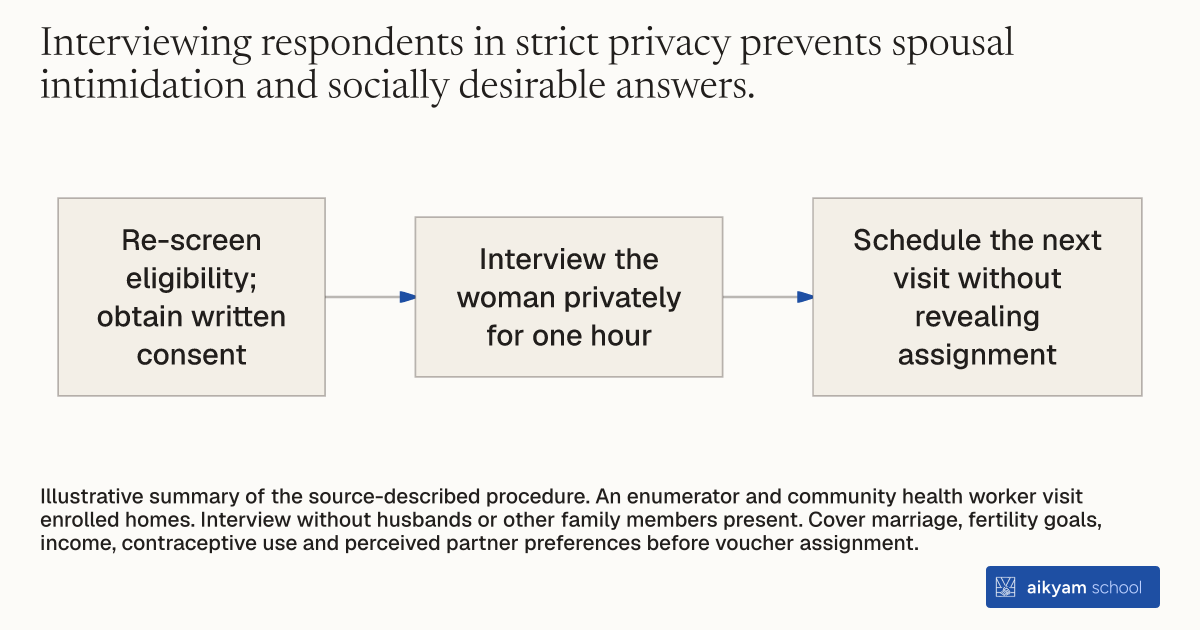
- Re-screen eligibility; obtain written consent
- Interview the woman privately for one hour
- Schedule the next visit without revealing assignment
Illustrative summary of the source-described procedure. An enumerator and community health worker visit enrolled homes. Interview without husbands or other family members present. Cover marriage, fertility goals, income, contraceptive use and perceived partner preferences before voucher assignment.
See source →How
When to use
Researchers need to measure sensitive personal choices and individual preferences without influence from other family members. Unobserved partner pressure distorts survey answers about birth control, desired family size, and domestic decisions. Administering private interviews before launching a program establishes clean baseline data on household bargaining.
Administer a private baseline household survey to married women without husbands or other family members present.
- Assign a team consisting of one enumerator and one community health worker to visit each enrolled home.
- Re-screen the respondent to verify eligibility criteria and obtain written informed consent.
- Conduct a one-hour structured interview covering marital history, fertility goals, income, and family planning knowledge.
- Record the respondent's reported preferences for contraceptive concealability and past unobserved birth control use.
- Elicit the wife's perception of her husband's ideal family size and desired birth timing.
- Schedule a second household visit for both spouses without revealing experimental group assignments.
Why it works
Collecting detailed baseline preferences before treatment assignment ensures that data remains uncorrupted by program interventions.
Example
Enumerators interviewed 749 eligible married women privately in Lusaka, Zambia between March and June 2007. The baseline survey gathered data on schooling, income, childbearing history, and spousal fertility agreement across both experimental arms before assigned vouchers were introduced.
About the study
Participants
749 married women aged 18 to 40 in Lusaka, Zambia.
Study Design
Private baseline household survey administered by an enumerator and community health worker prior to randomized voucher assignment.
Results
The baseline survey established that 88 percent of women had used modern contraceptives, 20 percent used injectables, and 13.8 percent reported using contraception without their husband's knowledge. Furthermore, 77 percent of wives preferred a method known only to themselves, while 59 percent of wives whose husbands claimed no contraception use were actively using birth control.