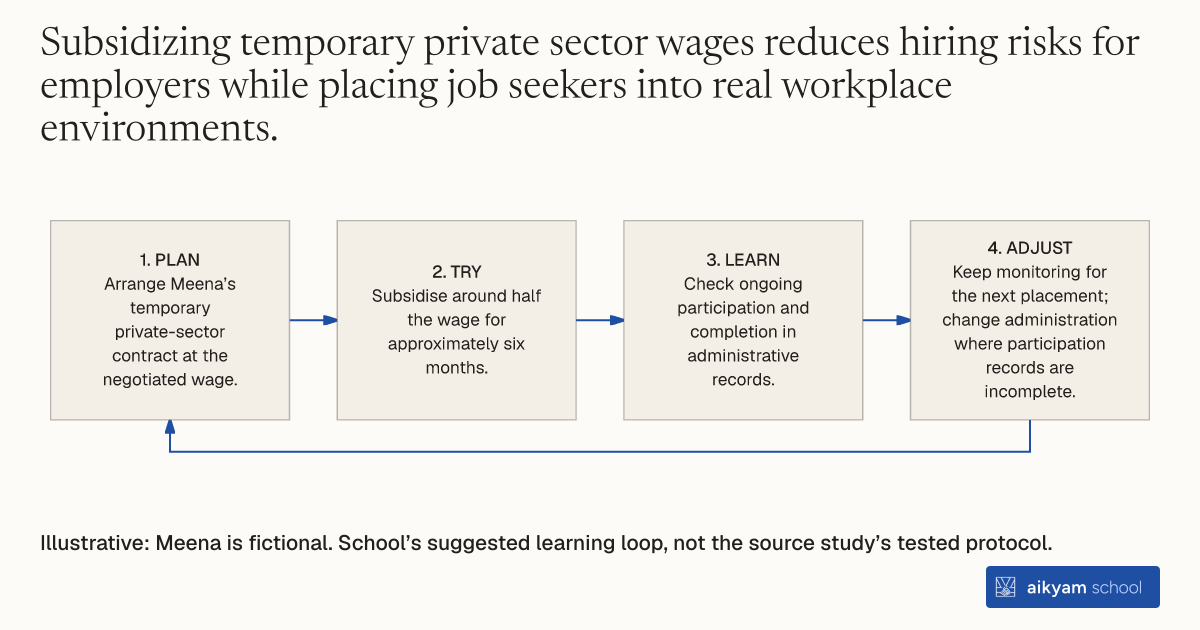
Try, learn and adjust
Check private subsidised placements
- Plan: Arrange Meena’s temporary private-sector contract at the negotiated wage.
- Try: Subsidise around half the wage for approximately six months.
- Learn: Check ongoing participation and completion in administrative records.
- Adjust: Keep monitoring for the next placement; change administration where participation records are incomplete.
Illustrative: Meena is fictional. School’s suggested learning loop, not the source study’s tested protocol.
See source →School’s suggested, untested loop. Observe participation and completion. Placement can reduce external job search during the programme.
How
When to use
Unemployed workers facing extended unemployment spells often struggle to secure unassisted private sector hires. Subsidized temporary employment in private firms bridges this barrier by offsetting initial wage costs for employers. Public employment agencies use this intervention for insured unemployed job seekers during active policy periods.
Place unemployed job seekers into subsidized temporary positions within private firms to facilitate workplace integration.
- Employment caseworkers identify private firms willing to host temporary positions for job seekers.
- The public employment agency negotiates a temporary employment contract at standard negotiated wage rates.
- The employment agency provides a wage subsidy covering approximately half of the worker's wage to the employer.
- Set the subsidized employment placement duration for approximately six months.
- Monitor ongoing participation and track program completion through central public administrative registers.
Why it works
However, active participation reduces job search time, creating temporary lock-in effects during placement weeks.
Example
Public job centers in Storstrøm and Southern Jutland placed treated job seekers in private subsidized positions during 2005 and 2006. Participation reached 8% to 12% among treated workers around weeks 20 to 30, compared to 4% to 6% among control workers.
About the study
Participants
N = 4,513 unemployed workers (Storstrøm: 1,174 treatment, 1,219 control; Southern Jutland: 1,055 treatment, 1,065 control) in Denmark.
Study Design
Randomized controlled trial assigning job seekers by birth date (1st–15th = treatment, 16th–31st = control) evaluated using mixed proportional hazard duration models.
Results
Active participation in private sector subsidized jobs exhibited negative lock-in effects on unemployment exit rates (coefficients of -1.15 for Storstrøm treatment and -1.10 for Southern Jutland treatment), demonstrating that program attendance temporarily reduces job search exits.