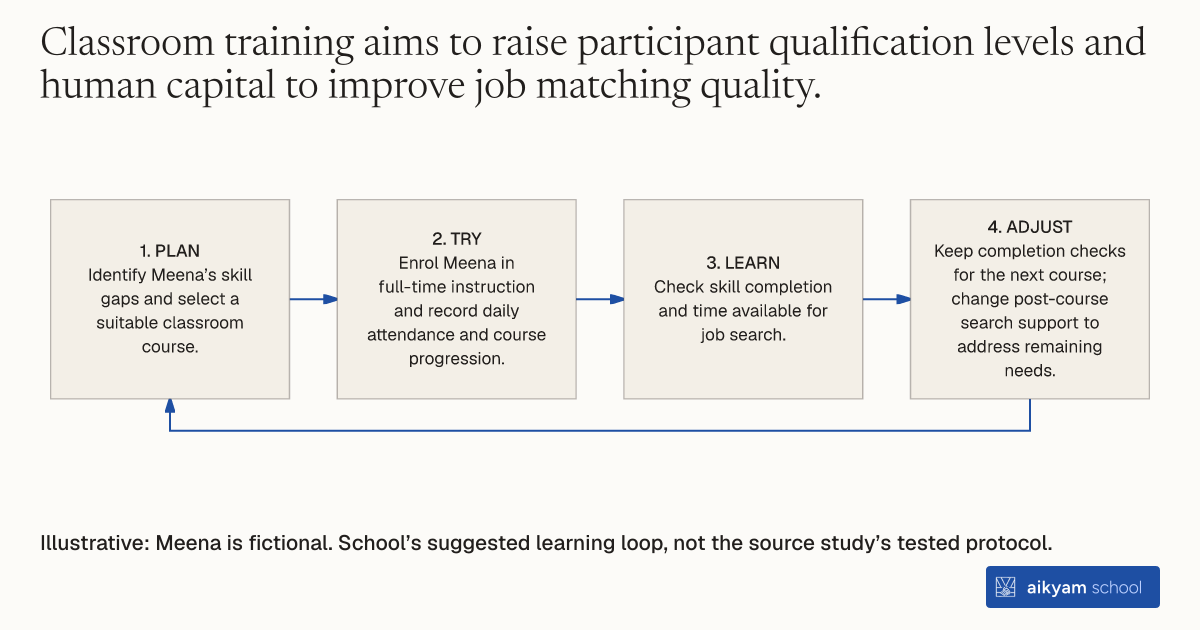
Try, learn and adjust
Check vocational course participation
- Plan: Identify Meena’s skill gaps and select a suitable classroom course.
- Try: Enrol Meena in full-time instruction and record daily attendance and course progression.
- Learn: Check skill completion and time available for job search.
- Adjust: Keep completion checks for the next course; change post-course search support to address remaining needs.
Illustrative: Meena is fictional. School’s suggested learning loop, not the source study’s tested protocol.
See source →School’s suggested, untested loop. Observe attendance, progression and skills. Full-time training can reduce job search during course weeks.
How
When to use
Unemployed job seekers often face skill gaps or lack formal qualifications required by hiring industries. Assigning job seekers to classroom vocational training courses aims to address skill deficiencies through structured academic and technical instruction. Public employment agencies use this program for insured unemployed workers during active labor market policy periods.
Assign unemployed benefit recipients to classroom vocational training courses to upgrade technical and academic qualifications.
- Employment caseworkers identify skill gaps and select appropriate vocational or educational training courses for unemployed clients.
- Enroll participants in classroom training courses ranging from short IT classes to multi-month vocational courses.
- Require participants to attend full-time educational instruction at certified training institutes or technical schools.
- Track daily attendance and monitor course progression through public employment register databases.
- Review participant skill completion and assist with post-course job search upon course conclusion.
Why it works
However, full-time class attendance reduces time available for active job search, creating negative lock-in effects during training weeks.
Example
Public job centers in Storstrøm and Southern Jutland assigned treated job seekers to classroom courses during 2005 and 2006. Participation rates in Storstrøm steadily increased to peak at 40% in week 45 for treatment group members (versus 15% for controls), while Southern Jutland reached a peak participation rate of 20% for treatment members (versus 5% for controls).
About the study
Participants
N = 4,513 unemployed workers across Storstrøm and Southern Jutland counties, Denmark.
Study Design
Randomized controlled trial assigning job seekers by birth date (1st–15th = treatment, 16th–31st = control) evaluated using mixed proportional hazard duration models.
Results
Active participation in classroom education exhibited statistically significant negative direct effects on exit rates into employment during course weeks (coefficients of -0.85 for Storstrøm treatment and -1.15 for Southern Jutland treatment), demonstrating that classroom training creates lock-in effects that temporarily depress job finding.