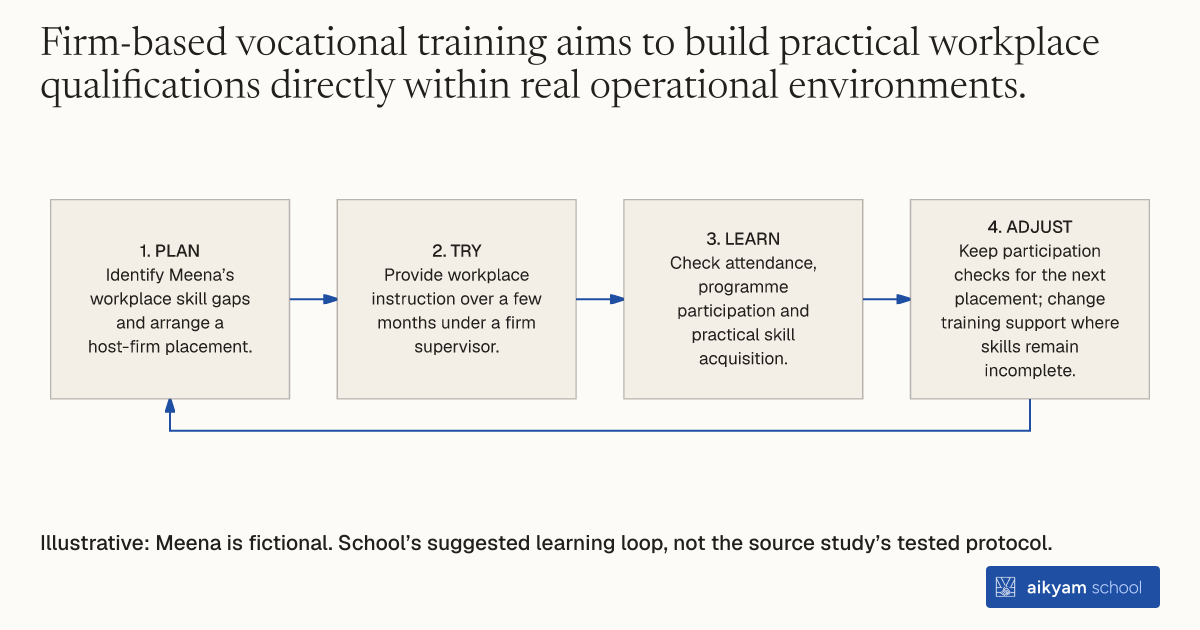
Try, learn and adjust
Check workplace training duties
- Plan: Identify Meena’s workplace skill gaps and arrange a host-firm placement.
- Try: Provide workplace instruction over a few months under a firm supervisor.
- Learn: Check attendance, programme participation and practical skill acquisition.
- Adjust: Keep participation checks for the next placement; change training support where skills remain incomplete.
Illustrative: Meena is fictional. School’s suggested learning loop, not the source study’s tested protocol.
See source →School’s suggested, untested loop. Observe attendance, participation and skills. Placement can reduce time available for external job search.
How
When to use
Unemployed job seekers often lack practical on-the-job vocational skills required by private sector employers. Assigning job seekers to vocational training placements within host firms provides workplace-based skill acquisition. Public employment agencies use this program for insured unemployed workers during active labor market policy periods.
Assign unemployed benefit recipients to vocational training programs hosted within operational firms to build practical workplace skills.
- Public employment caseworkers identify eligible unemployed individuals with specific workplace skill gaps.
- Case workers arrange vocational training placements within participating host firms.
- Enroll participants in firm-based training courses lasting a few months.
- Host firm supervisors provide workplace instruction and oversee practical skill acquisition.
- Track worker attendance and program participation through central administrative employment databases.
Why it works
However, active participation reduces hours available for external job search, causing temporary lock-in effects while training is underway.
Example
Public job centers in Storstrøm and Southern Jutland assigned unemployed workers to firm-based vocational training in 2005–2006. Participation rates in the control group remained around 1% across both counties, while treatment group members participated slightly more often in Southern Jutland county than in Storstrøm county.
About the study
Participants
N = 4,513 unemployed individuals across Storstrøm and Southern Jutland counties, Denmark.
Study Design
Randomized controlled trial assigning job seekers by birth date (1st–15th = treatment, 16th–31st = control) evaluated using mixed proportional hazard duration models.
Results
Active participation in firm-based vocational training exhibited negative direct effects on unemployment exit rates (hazard coefficients of -0.94 for Storstrøm treatment and -0.20 for Southern Jutland treatment), demonstrating that firm training creates temporary lock-in effects during participation.