Try, learn and adjust
Check private sanitation reports against follow-up audits
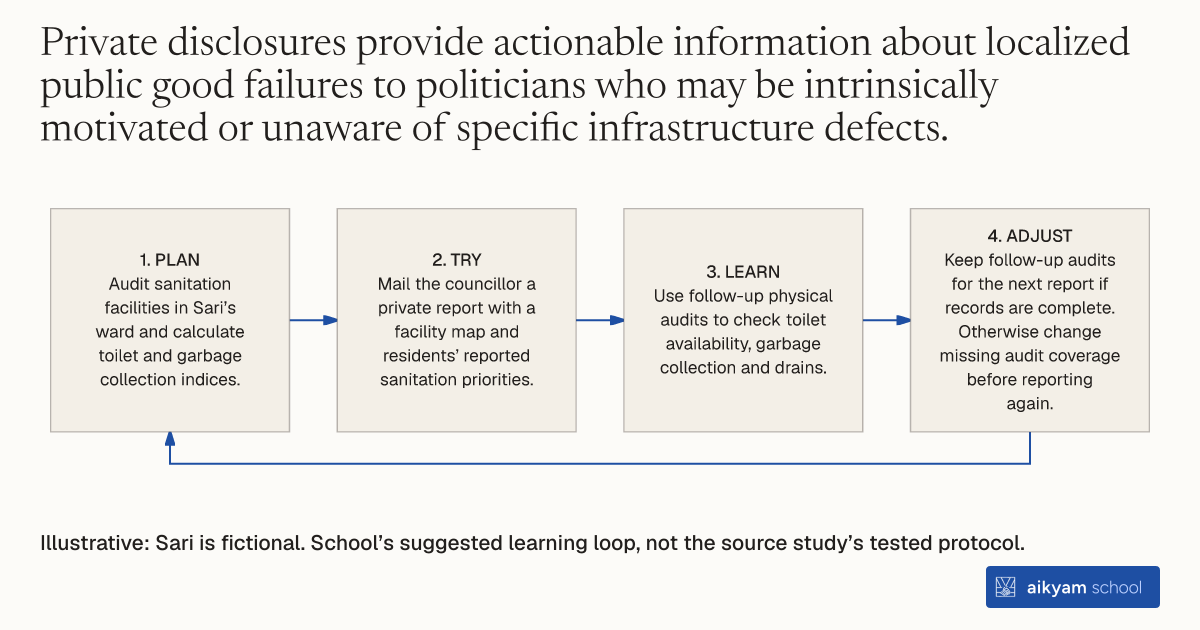
- Plan: Audit sanitation facilities in Sari’s ward and calculate toilet and garbage collection indices.
- Try: Mail the councillor a private report with a facility map and residents’ reported sanitation priorities.
- Learn: Use follow-up physical audits to check toilet availability, garbage collection and drains.
- Adjust: Keep follow-up audits for the next report if records are complete. Otherwise change missing audit coverage before reporting again.
Illustrative: Sari is fictional. School’s suggested learning loop, not the source study’s tested protocol.
See source →School’s suggested learning loop: observe audit records and facility conditions. Findings remain non-public; the private treatment showed no significant sanitation improvements.
How
When to use
Elected councilors and municipal managers often lack granular data on the physical condition of sanitation facilities in low-income slums. Public toilets, formal garbage dumps, and informal trash piles frequently deteriorate without official awareness or maintenance. Conducting private facility audits and sending direct reports to elected representatives provides actionable, non-public information to address localized public service failures.
Conduct physical audits of slum sanitation facilities and send non-public performance reports directly to elected municipal officials.
- Surveyors conduct physical field audits of public toilets, formal garbage dumps, and informal trash piles across slums in target municipal wards.
- Calculate slum-level toilet availability and garbage collection performance indices based on physical cleanliness, facility open status, user counts, and cleaning frequency.
- Enclose a ward map highlighting specific toilet and garbage facilities requiring immediate maintenance or repair.
- Attach a cover letter summarizing baseline survey data on the proportion of slum residents reporting sanitation and garbage as major problems.
- Mail private State of Sanitation Information audit reports directly to municipal councilors prior to municipal elections.
- Conduct follow-up physical audit rounds to measure changes in toilet availability, garbage collection, and drain maintenance.
Why it works
However, without public dissemination, politicians do not anticipate that voters or parties will observe and reward maintenance efforts, limiting the incentive to act.
Example
In Delhi, India, survey teams conducted three rounds of State of Sanitation Information audits across 310 slums in 108 high-slum-density wards. Reports from two audit rounds were mailed directly to treated councilors in August 2011 and February 2012, but the audit findings were not disclosed to the public or media. Treated councilors showed no statistically significant improvements in pro-poor spending, toilet availability, toilet pricing, formal pile removal, or informal garbage collection relative to control wards.
About the study
Participants
310 slums across 108 high-slum-density municipal wards in Delhi, India, with 932 slum-round audit observations across three rounds.
Study Design
A cross-cutting randomized controlled trial where assembly constituencies and wards were randomized into private information treatment and control groups to measure changes in public service provision and pro-poor spending.
Results
Private report card treatment had no significant impact on pro-poor spending (beta = -0.049), toilet availability index (beta = -0.048), toilet prices (beta = 0.065), total formal piles (beta = -0.087), or garbage collection index (beta = -0.055).