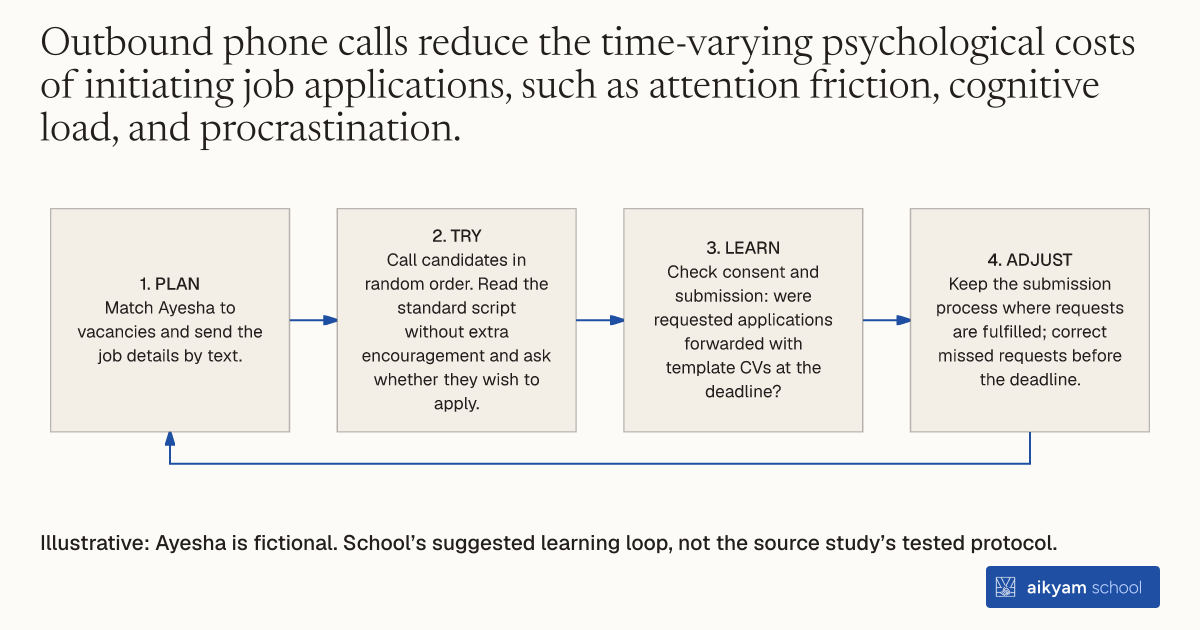
Try, learn and adjust
Check applications requested during outreach calls
- Plan: Match Ayesha to vacancies and send the job details by text.
- Try: Call candidates in random order. Read the standard script without extra encouragement and ask whether they wish to apply.
- Learn: Check consent and submission: were requested applications forwarded with template CVs at the deadline?
- Adjust: Keep the submission process where requests are fulfilled; correct missed requests before the deadline.
Illustrative: Ayesha is fictional. School’s suggested learning loop, not the source study’s tested protocol.
See source →School’s suggested loop, not a tested source procedure. Observe application requests and CV forwarding; do not infer employment from applications.
How
When to use
Jobseekers on employment platforms often fail to apply for suitable vacancies despite negligible monetary or time costs due to psychological initiation barriers. This method addresses under-search by shifting jobseekers from an active initiation role to a passive recipient role. It is intended for employment platforms, call centers, or labor exchange agencies serving urban jobseekers.
Initiate outbound phone calls to matched candidates to offer immediate application submission rather than requiring them to place incoming calls.
- Match jobseekers monthly to qualified open vacancies based on reported education, work experience, and occupational preferences.
- Send an automated text message listing job matches, salaries, locations, and application deadlines.
- Call center agents place outbound calls to candidates in random order immediately following text notifications.
- Agents read a standardized script listing match details without providing extra advice, encouragement, or pressure.
- Ask candidates if they wish to apply to any listed vacancy during the call.
- For candidates who agree, forward their standardized template CVs to employers in a batch at the deadline.
Why it works
Transitioning candidates from an active to a passive default process enables them to apply during moments when mental barriers otherwise prevent action.
Example
In Lahore, Pakistan, the Job Talash platform made outbound phone calls to 9,838 registered jobseekers who received matched job vacancies, offering to complete their applications on the spot. This outreach increased the proportion of jobseekers who ever applied from 21% to 44% and multiplied overall application rates sevenfold without reducing interview invitation rates.
About the study
Participants
N = 9,838 jobseekers (1,116,952 jobseeker-vacancy matches) across Lahore, Pakistan; 31% female, average age 30.7 years, average 7.9 years of work experience, ranging from primary to university education.
Study Design
Randomized controlled trial (RCT) over four years comparing outbound call initiation against passive text notifications requiring candidate-initiated calls, evaluated using two-stage least squares (2SLS) instrumental variables.
Results
Phone call outreach increased match application rates by 600% from 0.185% to 1.507% (effect = 0.01322, p < 0.001) and increased interview invitation rates sevenfold from 0.012% to 0.090% (effect = 0.00078, p < 0.001), yielding constant marginal returns (5.87% marginal interview rate vs 6.29% control rate, p = 0.647).