Research procedure
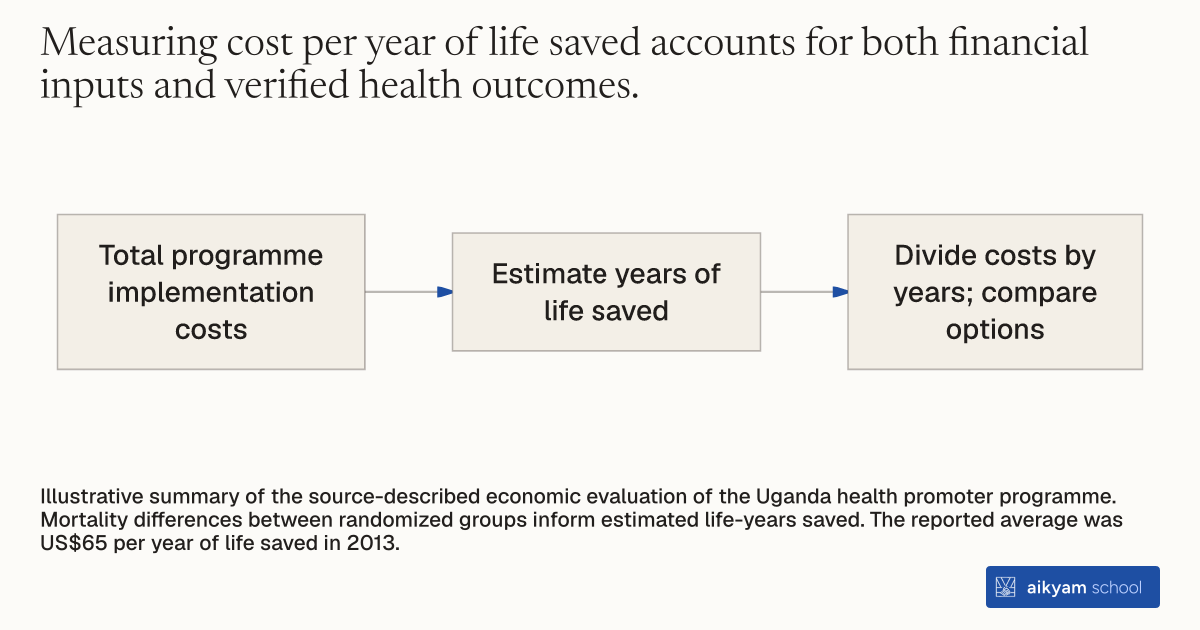
Calculate cost per year of life saved
- Total programme implementation costs
- Estimate years of life saved
- Divide costs by years; compare options
Illustrative summary of the source-described economic evaluation of the Uganda health promoter programme. Mortality differences between randomized groups inform estimated life-years saved. The reported average was US$65 per year of life saved in 2013.
See source →How
When to use
Health policy makers and donor organizations struggle to determine whether adding financial incentives to volunteer health programs is economically viable. Traditional volunteer programs often exhibit low cost-effectiveness due to high worker attrition and low activity. Calculating program cost-effectiveness in terms of dollars per year of life saved provides clear evidence to justify health investments in low-income settings.
Calculate the economic cost-effectiveness of a community health intervention per year of life saved.
- Program evaluators collect total implementation costs including promoter bonuses, wholesale product subsidies, training, and operational overhead.
- Demographers measure the net reduction in child, infant, and neonatal mortality across target community clusters compared to comparison groups.
- Analysts convert mortality reductions into total years of life saved across the surveyed population.
- Economists divide total program implementation expenses by the net years of life saved to establish a unit cost per life year gained.
- Decision makers compare the resulting dollar figure against benchmark cost-effectiveness ranges for alternative health interventions.
Why it works
This metric demonstrates that paying small performance incentives dramatically increases health impact relative to total program costs.
Example
Researchers evaluated the Living Goods and BRAC Uganda community health promoter model across 214 villages in Uganda, calculating that the intervention saved years of life at an average cost of US\$65 per year of life saved in 2013.
About the study
Participants
214 rural villages (115 treatment and 99 comparison villages) covering about 7,000 households and over 11,000 children in Uganda.
Study Design
Economic cost-effectiveness analysis based on a cluster randomized controlled trial measuring mortality reductions three years post-implementation.
Results
The average cost per year of life saved by community health promoters was US\$65 in 2013, compared to estimates for standard volunteer health programs ranging from US\$82 to US\$3,396 per year of life saved.