Research survey
Ask about support for redistributive climate policies
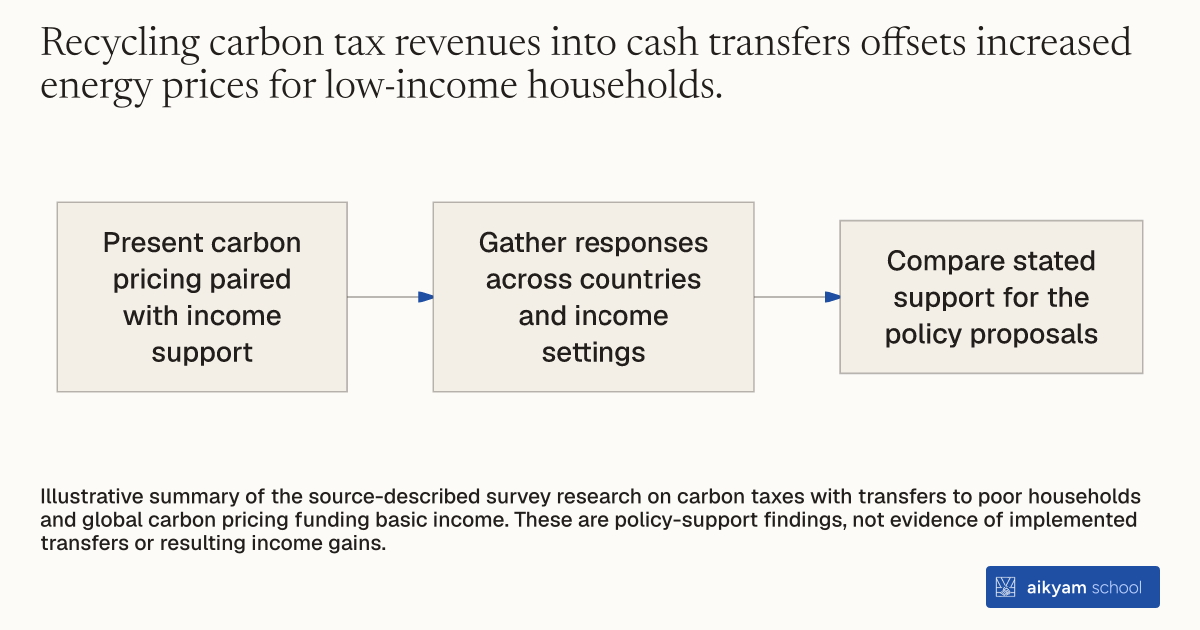
- Present carbon pricing paired with income support
- Gather responses across countries and income settings
- Compare stated support for the policy proposals
Illustrative summary of the source-described survey research on carbon taxes with transfers to poor households and global carbon pricing funding basic income. These are policy-support findings, not evidence of implemented transfers or resulting income gains.
See source →How
When to use
Carbon pricing policies face intense political opposition because higher fuel costs disproportionately burden low-income households. Standard energy tax proposals fail to gain public support when citizens anticipate rising living expenses without direct benefits. This method applies to policymakers seeking to build public consensus for carbon taxation while protecting low-income families.
Structure carbon pricing reforms to recycle collected tax revenues directly into redistributive cash transfers for low-income citizens.
- The government enacts a statutory carbon tax on fossil fuel consumption and emissions.
- Fiscal authorities collect carbon tax revenues from industrial polluters and fuel distributors into a dedicated public fund.
- The government establishes direct cash transfer accounts for low-income households.
- Fiscal authorities disburse regular redistributive cash transfers funded by carbon tax proceeds to target families.
- Communications officers publish transparent policy guidelines detailing how carbon revenues fund basic income support across global contexts.
Why it works
Directly returning proceeds builds widespread public support for climate reforms by ensuring poorer families benefit financially.
Example
In a large-scale global survey across multiple countries, researchers evaluated public support for progressive climate policies, finding that pairing a carbon tax with cash transfers to poor households or funding a global basic income significantly increased public acceptance.
About the study
Participants
Survey respondents across multiple low-, middle-, and high-income countries globally.
Study Design
Quasi-experimental survey experiments evaluating public support for progressive climate policies (Dechezleprêtre et al. 2025; Fabre et al. 2024).
Results
Coupling carbon pricing with direct cash transfers to poor households or a global basic income built widespread public consensus and support for climate policy adoption.