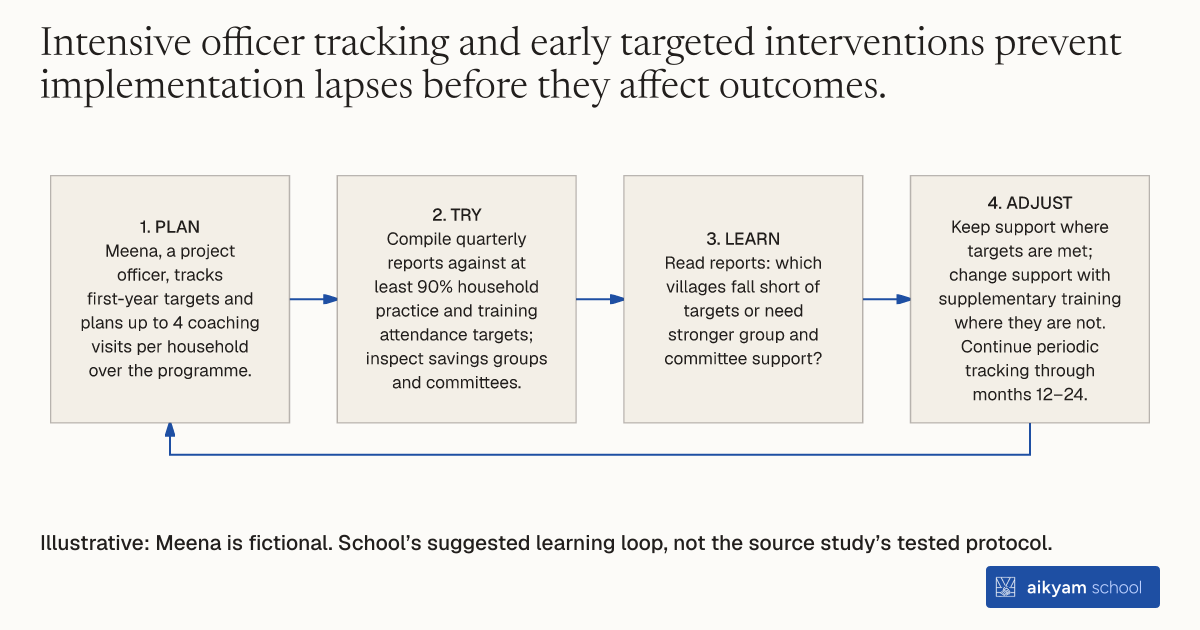
Try, learn and adjust
Check village progress against adoption targets
- Plan: Meena, a project officer, tracks first-year targets and plans up to 4 coaching visits per household over the programme.
- Try: Compile quarterly reports against at least 90% household practice and training attendance targets; inspect savings groups and committees.
- Learn: Read reports: which villages fall short of targets or need stronger group and committee support?
- Adjust: Keep support where targets are met; change support with supplementary training where they are not. Continue periodic tracking through months 12–24.
Illustrative: Meena is fictional. School’s suggested learning loop, not the source study’s tested protocol.
See source →School’s suggested, untested learning loop. Observe attendance, adoption, coaching visits and group functioning; the 90% benchmark is a target, not an assumed result.
How
When to use
Community-wide development programs often struggle with inconsistent adoption of taught practices and declining attendance over multi-year rollout periods. Conducting structured progress monitoring against quantitative targets combined with limited household coaching visits ensures high compliance. This method is intended for rural livelihood interventions relying on village-level training and committee governance.
Track village progress against adoption targets using project officers who conduct household coaching visits and trigger early interventions for underperforming communities.
- Assign project officers to track village progress closely against set performance targets during the first year of implementation.
- Conduct up to 4 individual coaching visits per household over the program period to reinforce recommended agricultural, livestock, and hygiene practices.
- Compile quarterly monitoring reports to verify that at least 90% of village households practice taught behaviors and attend trainings.
- Inspect Village Savings and Loan Associations and volunteer committees to confirm they operate effectively and fulfill mentorship duties.
- Deliver supplementary training and support to villages falling short of target benchmarks to bring all households up to speed.
- Follow up and track village progress periodically through months 12 to 24 until the community completes graduation.
Why it works
Limited household visits reinforce key training messages without creating dependency on high-cost, continuous one-on-one coaching.
Example
In rural western Uganda, Raising the Village deployed project officers to track targets and deliver up to 4 coaching visits per household, maintaining over 90% training attendance and achieving a 267% 3-year benefit-cost ratio.
About the study
Participants
3,852 households across 335 villages in Kagadi and Kyenjojo districts, western Uganda, where 35% of households fall below the $2.15 PPP daily poverty line post-harvest and 65% during the lean season.
Study Design
Clustered randomized controlled trial across 114 village clusters covering 335 villages, comparing a universal livelihoods program to a pure control group.
Results
Over 90% of households attended trainings (84% completed all four training types), 90% adopted key behaviors, monthly income increased by USD 40.703 PPP (26%, p < 0.01), and the 3-year benefit-cost ratio reached 267%.