Research steps
Invite a promise to refuse money
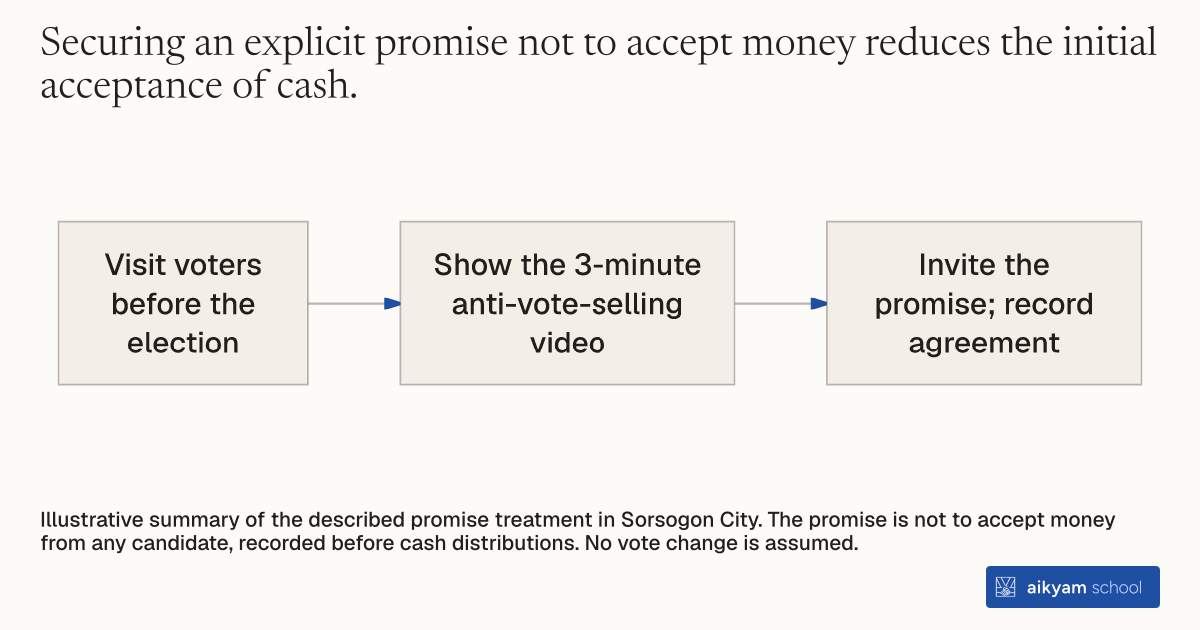
- Visit voters before the election
- Show the 3-minute anti-vote-selling video
- Invite the promise; record agreement
Illustrative summary of the described promise treatment in Sorsogon City. The promise is not to accept money from any candidate, recorded before cash distributions. No vote change is assumed.
See source →How
When to use
Developing democracies face widespread vote-buying by candidates in the days before an election. Civil society organizations need interventions that reduce vote-selling among targeted voters. This method applies to registered voters in electoral districts where candidates distribute cash.
Invite voters during baseline visits to promise not to accept money from any election candidate.
- Enumerators visit voters at their households during the month leading up to an election.
- Enumerators screen a three-minute civic video urging voters not to sell their votes.
- Enumerators invite participants to promise not to accept money from any candidates.
- Enumerators record the agreement before candidate cash distributions begin.
Why it works
Preventing voters from accepting money eliminates the temptation and felt obligation to vote for a vote-buying candidate.
Example
In Sorsogon City, Philippines, enumerators asked baseline survey respondents to promise not to accept money before the May 2013 elections, which significantly reduced vote-switching in city council races where payments ranged from 20 to 100 pesos.
About the study
Participants
883 surveyed households across three electoral races in Sorsogon City, Philippines during the May 2013 elections.
Study Design
Randomized field experiment evaluating the effect of promising not to accept money against a control group and a conscience-voting pledge group.
Results
Inviting voters to promise not to accept money substantially reduced vote-switching, with all reductions concentrated in the city council election where candidate payments were smallest.