Research steps
Invite a conscience-voting promise
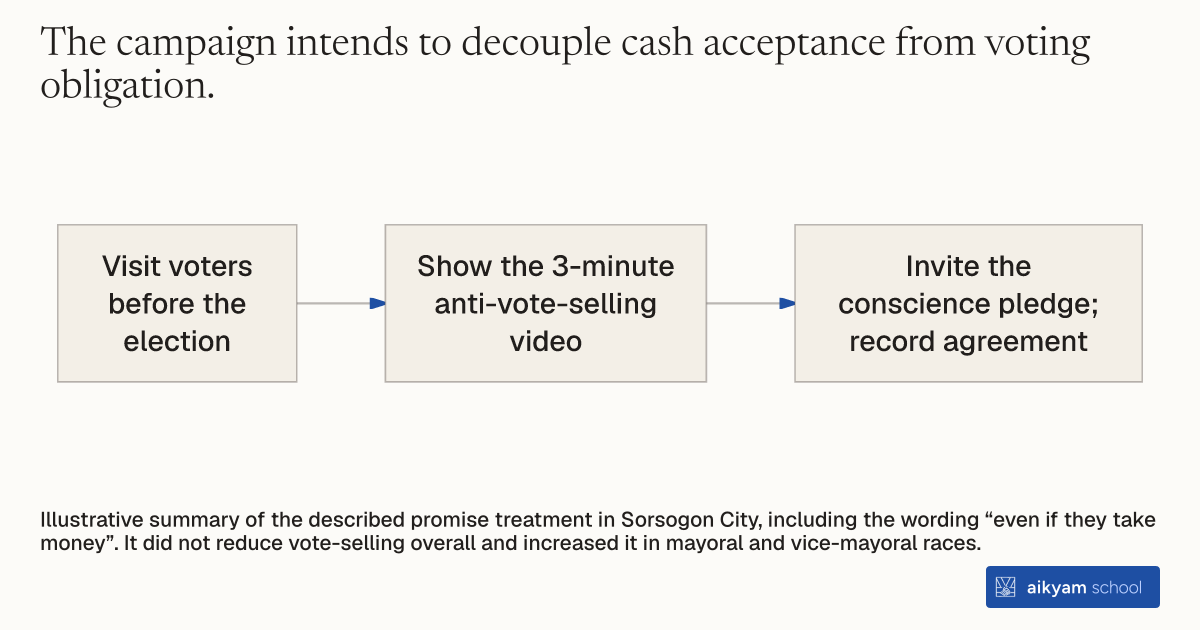
- Visit voters before the election
- Show the 3-minute anti-vote-selling video
- Invite the conscience pledge; record agreement
Illustrative summary of the described promise treatment in Sorsogon City, including the wording “even if they take money”. It did not reduce vote-selling overall and increased it in mayoral and vice-mayoral races.
See source →How
When to use
In developing democracies with pervasive vote-buying, civil society anti-vote-selling campaigns often encourage voters to accept candidates' cash while voting according to their true preference. This method applies to registered voters in elections where candidate monetary offers are high and widespread.
Ask voters during pre-election household visits to make a promise to vote their conscience even if they accept cash from candidates.
- Enumerators visit voters in their homes during the month leading up to an election.
- Enumerators show a three-minute civic education video discouraging vote-selling.
- Enumerators ask voters to promise to "vote your conscience," even if they take money from a candidate.
- Enumerators record whether the voter agrees to make the pledge.
Why it works
However, encouraging voters to accept money increases overall cash acceptance, exposing voters to stronger-than-anticipated feelings of reciprocity and temptation that actually increase vote-selling when candidate cash offers are large.
Example
In Sorsogon City, Philippines, enumerators asked voters before the May 2013 elections to promise to vote their conscience even if taking money; this backfired by increasing vote-switching in mayoral and vice-mayoral races offering 250 to 500 pesos.
About the study
Participants
883 surveyed households across mayoral, vice-mayoral, and city council races in Sorsogon City, Philippines during the May 2013 elections.
Study Design
Randomized field experiment evaluating the effect of a "vote your conscience" promise treatment compared to a control group and a "promise not to accept money" treatment.
Results
Asking voters to promise to vote their conscience did not reduce vote-switching overall, and actually increased vote-selling in the mayoral and vice-mayoral races where larger sums (250–500 pesos) were offered.