Research steps
List and sample young jobseekers
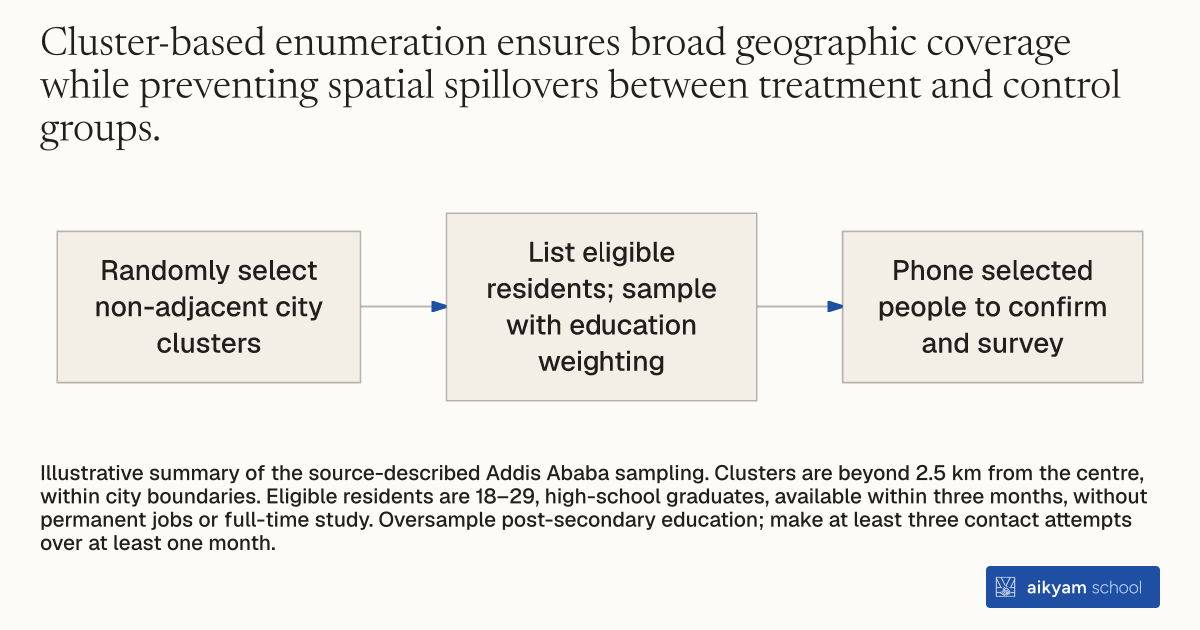
- Randomly select non-adjacent city clusters
- List eligible residents; sample with education weighting
- Phone selected people to confirm and survey
Illustrative summary of the source-described Addis Ababa sampling. Clusters are beyond 2.5 km from the centre, within city boundaries. Eligible residents are 18–29, high-school graduates, available within three months, without permanent jobs or full-time study. Oversample post-secondary education; make at least three contact attempts over at least one month.
See source →How
When to use
Use this method when constructing a representative population sample of young urban jobseekers in developing labor markets where official registries do not exist. It addresses the problem of reaching unregistered, educated unemployed youth across diverse neighborhoods. It serves researchers, non-profit organizations, and policymakers seeking unbiased baseline data on youth employment.
Identify and survey eligible young jobseekers through structured cluster listing and screening in urban enumeration areas.
- Define geographic clusters using standard central statistical agency enumeration areas located beyond 2.5 kilometers from the city center and within city boundaries.
- Select enumeration clusters at random while dropping directly adjacent clusters to prevent geographic spillovers.
- Conduct door-to-door visits in each selected cluster to list residents aged 18 to 29 who completed high school, are available for work within three months, and lack permanent jobs or full-time student status.
- Draw a random sample of listed individuals while over-sampling candidates with post-secondary education to ensure subgroup representation.
- Contact selected individuals by phone for at least one month with at least three contact attempts to confirm willingness to participate and complete baseline interviews.
Why it works
Door-to-door screening reaches unemployed youth who do not appear on official government job registries.
Example
Researchers in Addis Ababa, Ethiopia selected non-adjacent enumeration clusters across the city to locate young jobseekers. Enumerators surveyed housing units door-to-door, identified 4,388 eligible individuals, and retained 4,059 participants after screening out permanent jobholders and migrants.
About the study
Participants
N = 4,059 young jobseekers aged 18 to 29 with high school education or above in Addis Ababa, Ethiopia.
Study Design
Stratified cluster sampling across Central Statistical Agency enumeration areas with door-to-door household listing and over-sampling of tertiary-educated youth.
Results
Reached 4,388 eligible respondents and maintained a final analytical sample of 4,059 individuals, achieving a 93.3% endline follow-up rate.