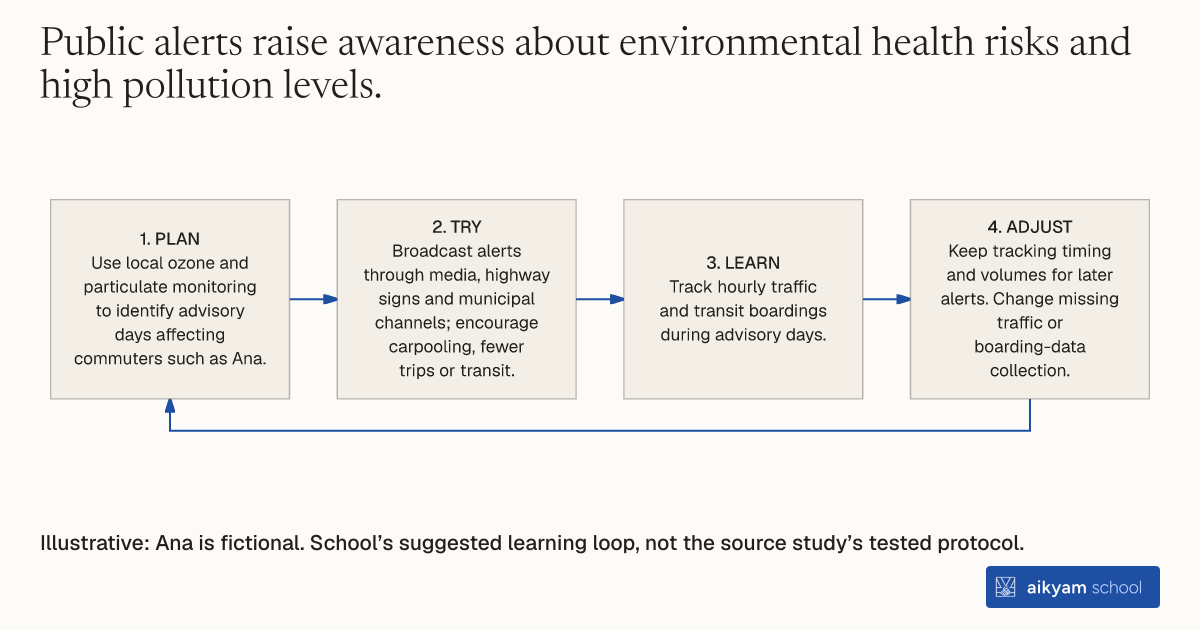
Try, learn and adjust
Check air alerts against travel patterns
- Plan: Use local ozone and particulate monitoring to identify advisory days affecting commuters such as Ana.
- Try: Broadcast alerts through media, highway signs and municipal channels; encourage carpooling, fewer trips or transit.
- Learn: Track hourly traffic and transit boardings during advisory days.
- Adjust: Keep tracking timing and volumes for later alerts. Change missing traffic or boarding-data collection.
Illustrative: Ana is fictional. School’s suggested learning loop, not the source study’s tested protocol.
See source →School’s suggested learning loop: observe hourly traffic, transit use and timing. Reported overall travel effects were minimal; broadcasting alerts does not establish reduced driving.
How
When to use
Municipalities issue air quality alerts during peak pollution days to encourage commuters to alter travel habits. High background automobile traffic and established commuting routines lead drivers to ignore advisory notices. Public advisory programs inform residents about elevated smog levels to reduce driving and boost transit use.
Issue public air quality advisory alerts to discourage single-occupancy vehicle driving during high-pollution days.
- Monitor urban ozone and particulate matter concentration levels using local monitoring stations.
- Declare public advisory days, such as Spare the Air or Ozone Action Day alerts, when air pollution thresholds are exceeded.
- Broadcast advisory warnings across public media, digital highway signs, and municipal communication channels.
- Encourage commuters to carpool, postpone non-essential motor trips, or substitute driving with public transit.
- Track hourly traffic congestion metrics and public transit ridership volumes across metropolitan corridors.
Why it works
Broad advisory warnings appeal to civic responsibility, prompting a small subset of commuters to adjust their travel timing or switch transport modes.
Example
Metropolitan advisory campaigns, including Spare the Air in San Francisco and Ozone Action Day in Chicago, issued public warnings on high-ozone days. Evaluators found minimal overall changes in automobile driving or transit enrollment, though some corridors experienced minor traffic reductions and temporary shifts in hourly ridership patterns.
About the study
Participants
Commuters, motorists, and public transit passengers across metropolitan regions including San Francisco, California, and Chicago, Illinois.
Study Design
Regression discontinuity design and difference-in-differences measuring highway traffic counts, transit boardings, and hourly travel distribution.
Results
Air quality alerts produced minimal effects on overall traffic congestion, transit ridership, or carpooling rates. However, evaluators observed minor traffic volume decreases and small shifts in transit boarding times toward less crowded hours.