Try, learn and adjust
Check transit fares and peak-hour travel
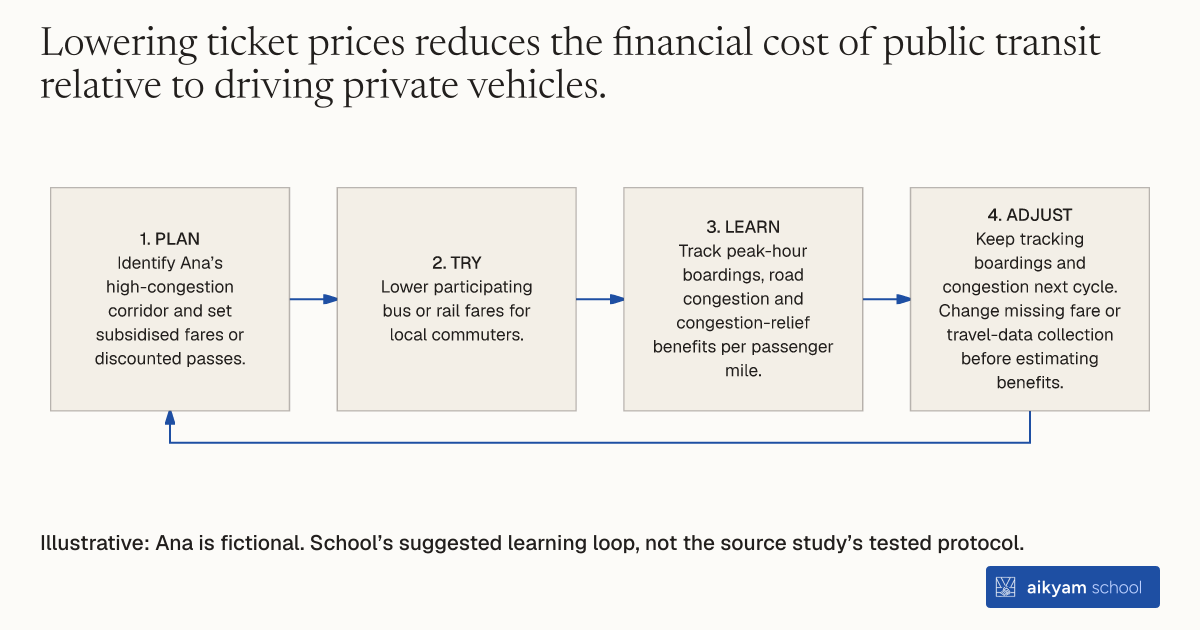
- Plan: Identify Ana’s high-congestion corridor and set subsidised fares or discounted passes.
- Try: Lower participating bus or rail fares for local commuters.
- Learn: Track peak-hour boardings, road congestion and congestion-relief benefits per passenger mile.
- Adjust: Keep tracking boardings and congestion next cycle. Change missing fare or travel-data collection before estimating benefits.
Illustrative: Ana is fictional. School’s suggested learning loop, not the source study’s tested protocol.
See source →School’s suggested learning loop: observe fares, boardings and congestion. School’s loop does not itself establish that subsidies caused congestion relief.
How
When to use
Metropolitan regions face heavy traffic congestion, air pollution, and high peak-hour highway delays. High public transit fares discourage daily drivers from shifting away from private motor vehicles. Fare subsidies lower transit costs to increase bus and rail ridership among urban commuters.
Reduce public transit passenger fare rates to increase transit boardings and ease highway traffic congestion.
- Identify high-congestion urban transit corridors and peak travel hours.
- Establish public transit fare subsidies or discounted pass rates for local commuters.
- Lower bus or rail ticket prices across participating municipal transit networks.
- Monitor peak-hour passenger boardings and highway traffic congestion reductions on inner-city roads.
- Calculate localized congestion relief benefits per passenger mile to measure overall policy cost-effectiveness.
Why it works
Increasing transit ridership during peak hours takes passenger cars off congested highways, producing major societal monetary savings through reduced travel delays.
Example
Evaluations in Los Angeles and the Netherlands measured the impact of public transit fare subsidies on ridership and highway traffic. Subsidizing transit fares successfully increased passenger boardings, generating substantial monetary congestion relief benefits worth up to 50 percent of the subsidy amount in the Netherlands and $1.20 to $4.10 per peak-hour passenger mile in Los Angeles.
About the study
Participants
Public transit riders and highway commuters across Los Angeles, California, and nationwide urban transit corridors in the Netherlands.
Study Design
Regression discontinuity design and quasi-natural experiments evaluating transit ticket pricing changes, passenger mile counts, and inner-city traffic congestion.
Results
Transit fare subsidies effectively increased transit usage and generated substantial congestion relief benefits, equaling up to 50 percent of the subsidy cost in the Netherlands and $1.20 to $4.10 per peak-hour transit passenger mile in Los Angeles, with benefits strongest during weekday rush hours on inner-city roads.