Try, learn and adjust
Check shared travel and transit use
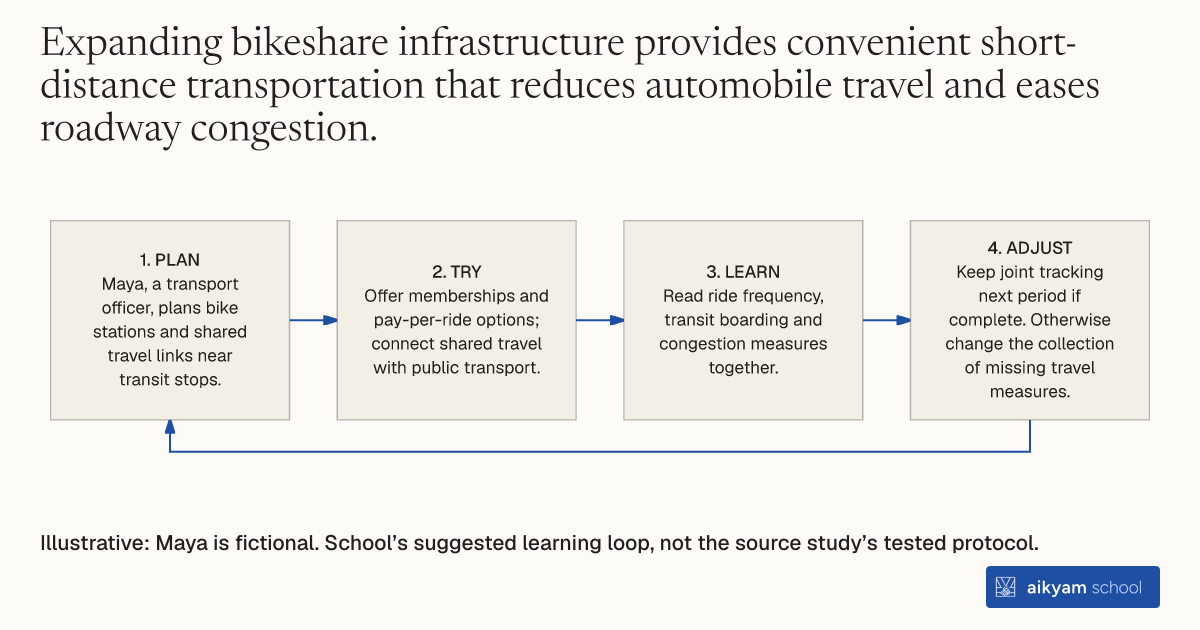
- Plan: Maya, a transport officer, plans bike stations and shared travel links near transit stops.
- Try: Offer memberships and pay-per-ride options; connect shared travel with public transport.
- Learn: Read ride frequency, transit boarding and congestion measures together.
- Adjust: Keep joint tracking next period if complete. Otherwise change the collection of missing travel measures.
Illustrative: Maya is fictional. School’s suggested learning loop, not the source study’s tested protocol.
See source →School’s suggested, untested learning loop. Observe bike rides, transit boardings and congestion. Bikeshare and ride-hailing need not affect transit use alike.
How
When to use
Urban areas face motor vehicle traffic congestion and high travel emissions from short-distance trips. Commuters lack flexible low-cost transport options for first-and-last-mile connections. Municipalities expand bikeshare networks and integrate shared ride services to provide clean micro-mobility alternatives.
Expand municipal bikeshare networks and integrate ride-hailing services to offer alternative transit options.
- Deploy shared bicycle and e-bike docking stations across target urban commuting corridors.
- Offer annual bikeshare memberships and flexible pay-per-ride options for municipal residents.
- Integrate micro-mobility options alongside public transit stops and commercial ride-hailing platforms.
- Track annual member ride frequencies and public transit boarding variations across active service zones.
- Measure metropolitan traffic congestion changes following bikeshare network expansions.
Why it works
Ride-hailing services complement public transportation by serving as first-and-last-mile feeder connections to transit stations.
Example
Program evaluations across Washington, D.C., and Minnesota evaluated bikeshare network expansions and ride-hailing platforms like Uber. Expanding bikeshare coverage increased ride frequency among annual members and reduced local traffic congestion, though bikeshare also reduced bus transit ridership while ride-hailing complemented public transit lines.
About the study
Participants
Bikeshare members, transit passengers, and ride-hailing commuters in Washington, D.C., Minnesota, and nationwide across the United States.
Study Design
Quasi-experiments using propensity score matching, two-way fixed effects, and difference-in-differences measuring transit ridership and traffic congestion.
Results
Bikeshare expansion increased riding frequency among annual members and reduced roadway traffic congestion, but reduced public transit ridership. Conversely, ride-hailing services like Uber functioned as a complement to public transit agencies rather than a substitute.