Try, learn and adjust
Check live arrival information and passenger waits
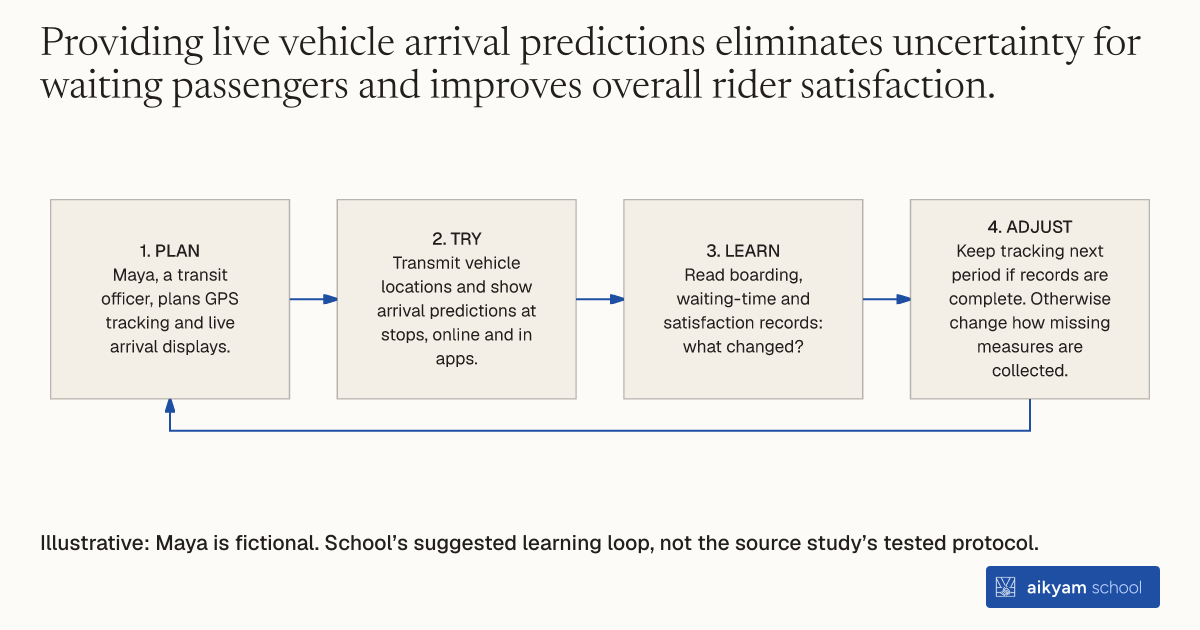
- Plan: Maya, a transit officer, plans GPS tracking and live arrival displays.
- Try: Transmit vehicle locations and show arrival predictions at stops, online and in apps.
- Learn: Read boarding, waiting-time and satisfaction records: what changed?
- Adjust: Keep tracking next period if records are complete. Otherwise change how missing measures are collected.
Illustrative: Maya is fictional. School’s suggested learning loop, not the source study’s tested protocol.
See source →School’s suggested, untested learning loop. Observe weekday boardings, wait durations and passenger satisfaction; these measures can change differently.
How
When to use
Commuters experience uncertainty regarding public transit scheduling and bus arrival times. Long perceived wait times at stops discourage prospective transit passengers from taking public transportation. Real-time arrival tracking systems provide live location data to passengers to reduce wait times and encourage transit use.
Deploy digital tracking hardware and public arrival displays to provide commuters with real-time transit schedule information.
- Install GPS location tracking devices across municipal bus and rail fleets.
- Transmit real-time vehicle location feeds to central transit processing servers.
- Display live arrival predictions on electronic stop signage, web portals, and mobile transit applications.
- Monitor changes in weekday passenger boardings across major transit routes.
- Measure commuter wait duration and passenger satisfaction levels at transit stops.
Why it works
Decreasing perceived and actual wait times lowers the non-monetary cost of choosing public transit over driving.
Example
Transit authorities in New York City, Chicago, and Tampa provided real-time vehicle tracking data to bus passengers. Real-time information increased weekday bus ridership on major routes in New York City and Chicago, while in Tampa it decreased passenger wait times and raised rider satisfaction without shifting total trip volumes.
About the study
Participants
Public transit passengers and bus commuters across New York City, New York; Chicago, Illinois; and Tampa, Florida.
Study Design
Difference-in-differences and natural experiments measuring weekday transit boardings, wait durations, and rider satisfaction.
Results
Provision of real-time arrival tracking increased weekday bus ridership on larger routes in New York City and Chicago. In Tampa, Florida, real-time information did not shift total bus trip volume, but decreased wait times and improved rider satisfaction.