Research design
Allocate cups by public lottery
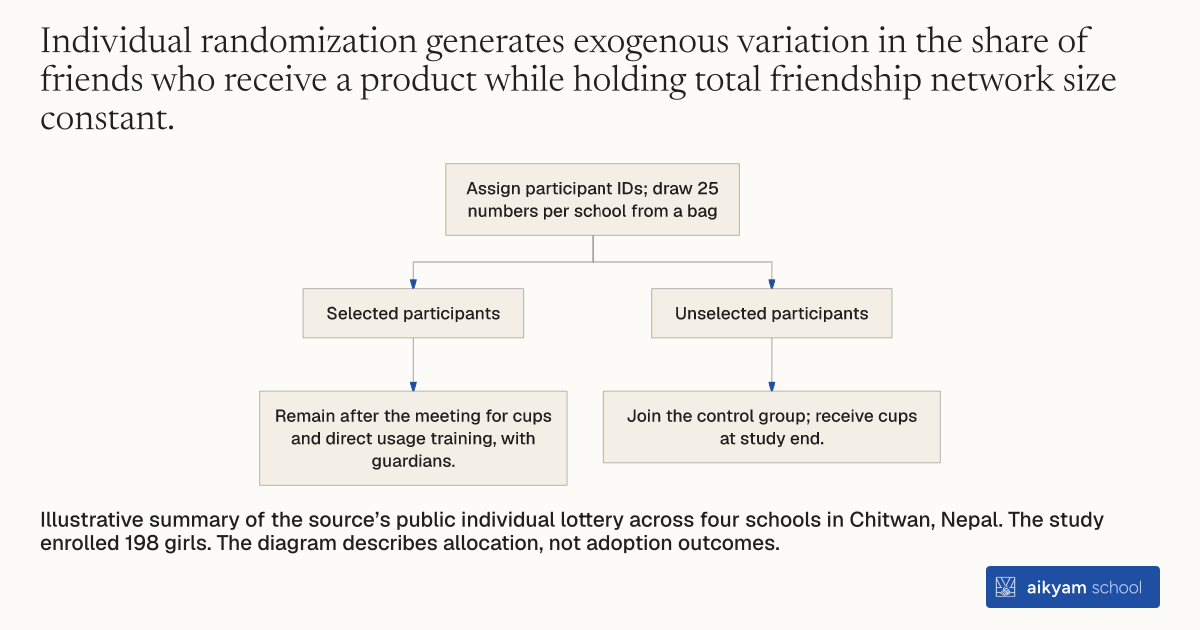
Assign participant IDs; draw 25 numbers per school from a bag
- Selected participants
- Remain after the meeting for cups and direct usage training, with guardians.
- Unselected participants
- Join the control group; receive cups at study end.
Illustrative summary of the source’s public individual lottery across four schools in Chitwan, Nepal. The study enrolled 198 girls. The diagram describes allocation, not adoption outcomes.
See source →How
When to use
Organisations need to allocate scarce health products transparently among eligible study participants. Standard cluster allocation can obscure peer effects and create perceived unfairness among participants. Public individual lotteries generate exogenous variation in product ownership while maintaining participant trust.
Allocate new technology items individually through a public random drawing at an initial participant gathering.
- Assign unique identification numbers to all enrolled participants at the conclusion of an introductory enrollment session.
- Place all assigned identification numbers into an opaque bag for a public drawing in front of attendees.
- Draw twenty-five identification numbers from the bag at each target location to select treatment recipients.
- Assign the selected participants and their co-attending guardians to the treatment group while assigning unselected participants to control.
- Retain treatment recipients after the general meeting to receive the distributed technology and direct usage training.
- Inform control group participants that they will receive the technology product at the end of the study period.
Why it works
Public drawing prevents selection bias and ensures transparent assignment in front of participants.
Example
In four schools across Chitwan, Nepal, study staff assigned identification numbers to 198 adolescent girls and drew 25 numbers per school from a bag, assigning half the total sample to receive menstrual cups and holding the remaining half as controls.
About the study
Participants
198 adolescent female students in 7th and 8th grades across four schools in Chitwan District, Nepal.
Study Design
Individual public bag lottery drawn at baseline, selecting 25 girls per school for immediate menstrual cup receipt and assigning remaining girls to delayed control.
Results
50% of participants were randomized into treatment; 1 additional treatment friend increased cup usage by 18.6 percentage points at two months.