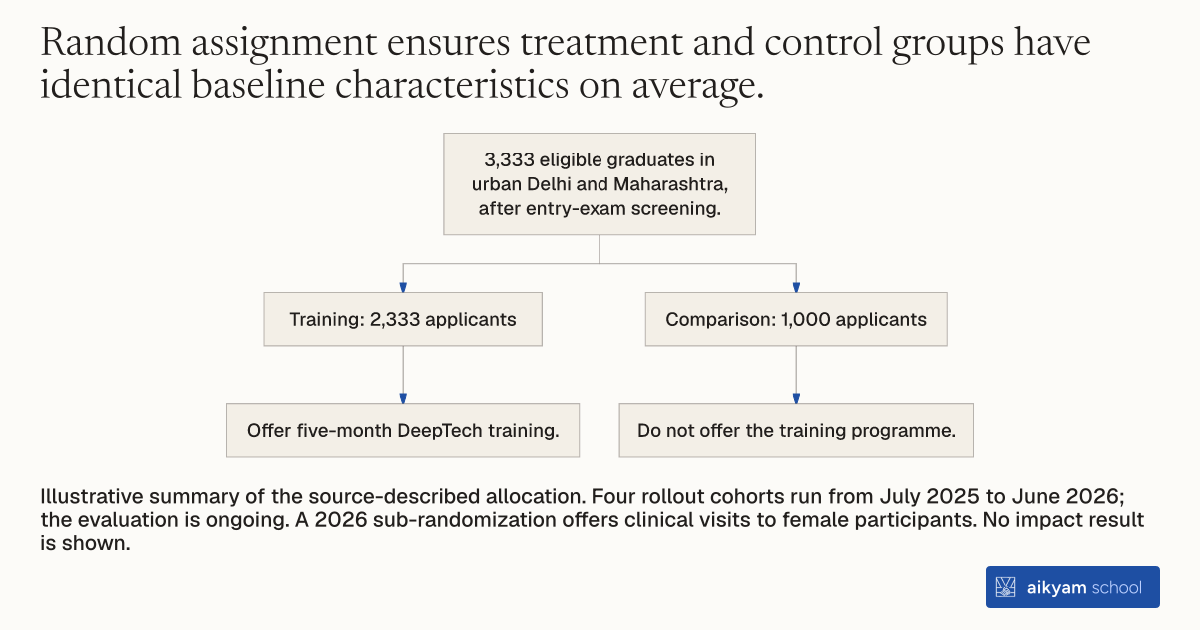
Research flow
Randomly allocate qualified applicants
3,333 eligible graduates in urban Delhi and Maharashtra, after entry-exam screening.
- Training: 2,333 applicants
- Offer five-month DeepTech training.
- Comparison: 1,000 applicants
- Do not offer the training programme.
Illustrative summary of the source-described allocation. Four rollout cohorts run from July 2025 to June 2026; the evaluation is ongoing. A 2026 sub-randomization offers clinical visits to female participants. No impact result is shown.
See source →How
When to use
Researchers need to measure the causal impacts of job training on employment and family planning outcomes without bias. Comparing self-selected trainees to non-trainees creates confounding results due to baseline differences in motivation. Randomly allocate eligible study applicants into treatment and comparison groups over a three-year period.
Randomly assign qualified training applicants into treatment and control groups across multiple rollout cohorts.
- Screen prospective job training applicants through an entry examination to establish an eligible study sample.
- Divide applicants into treatment and comparison groups using a randomized allocation procedure.
- Offer the five-month DeepTech training program to participants in the treatment group.
- Maintain the comparison group without offering training to serve as a baseline counterfactual.
- Stagger treatment delivery across four cohort rollouts between July 2025 and June 2026.
Why it works
Comparing outcomes across randomly assigned groups isolates the true causal effect of the training intervention.
Example
Researchers randomly assigned 3,333 applicants in urban Delhi and Maharashtra into 2,333 training recipients and 1,000 control group members.
About the study
Participants
3,333 low-income college graduates (2,333 men and 1,000 women) with engineering or computer science degrees in urban Delhi and Maharashtra, India.
Study Design
Randomized controlled trial allocating participants across four cohort rollouts between July 2025 and June 2026, with a sub-randomization offering clinical visits to female participants in 2026.
Results
2,333 participants were randomly assigned to DeepTech training and 1,000 participants to the comparison group; long-term impact evaluation results are ongoing.